Sion’s Handicap

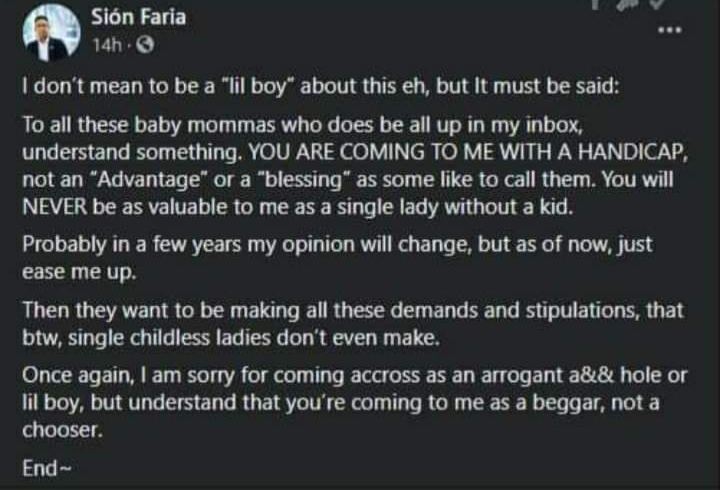
Well…it has been about one day since Trini Facebook was broken and now, it is nursing its wounds. In a viral post (screenshot below), one member of the red man association expressed frustration with the single mothers allegedly in his inbox. He had had enough and the day of reckoning was upon the beggars and their handicaps! Although I am of the view that too much has been said through comments and reposts, and although the original post has since been removed, I have a nagging desire to give my two cents on the matter. This is, after all, a blog about law, economics and Caribbean culture. And, this is culture! Besides, what else am I supposed to do in this lockdown?

To get it out of the way, it is objectively true that single mothers are at a disadvantage on the dating and marriage market. Men generally do not want to raise other men’s children. Hell, some men *cough black men cough* don’t even want to raise their own children. Don’t shoot the messenger because she’s having a bit of fun speaking the truth! That’s a discussion for another day and it is what it is. Bottom line is, the core idea of the post is true and Stevie Wonder could see that…

Nevertheless, I do take issue with the delivery. You see, there is a certain level of elegance that I expect of supposedly decent folk while they are in public, and this fell way below that standard. You can be right and be an a-hole (he accurately described himself as such), or you can be right while maintaining tact. As someone prone to bluntness who has had to rein it in to maintain healthier human interactions, I would know. Using the word handicap to describe a prospective mate’s children can be technically correct, but it is bound to leave a bad taste in people’s mouths. He was at liberty to make his statement, but I’m not at all surprised by people’s reactions. Some things are better if kept in one’s head instead of letting them roll off one’s tongue.

Nothing prevented the poster from exercising his agency in dating privately, but he made his PSA on Facebook…publicly…and THAT is where I think the juicy point can be made. Why did he do this? Was he really so frustrated that he had to? Were there so many unsavoury women in his inbox that making a public statement was rendered necessary? I think not and I must scrutinize the post!

The allegation was that there were “all these baby mommas” in his inbox. I find this improbable. On average, men do the asking and not women. Single mothers also tend to have a lot on their plates given that they have whole other humans for whom they are responsible. That many within this cohort had the time to be in his inbox seems highly unlikely to me. It may be true, but I find it difficult to believe.

The second allegation was that they were “demanding things which single, childless women do not demand”. I’m not sure whom he has been dealing with, but most women would not ask for things from men unless they have had some encouragement from those men. Perhaps I am mistaken, but I don’t know one woman who would do this without there first being some sort of rapport between herself and the man, and without gauging the probable outcome of making such a request and concluding that more likely than not, it would be positive.

Long story short, I think he made the post to get attention. He likely was trying to make it seem like he was in high demand so that some woman whom he was interested in would consider him a better prospect.

Well…attention he got! Single mothers (and some others) swarmed in to scold him! One does not just pelt a jep’s nest! Many, quite ironically, proved his point by not being aware that they were at a dating disadvantage… But, people were also noting his arrogance. I felt for him, but was VERY entertained, especially since the post had been shared early yesterday by a friend, and I paid it no mind. I took a nap and woke up to memes! Someone needs to apologise to Mouttxt on behalf of Trinbago!

The part of the original post which I found most fascinating, however, was “you are coming to me as a beggar, not a chooser”. It reeked of so much condescension that it made me want to investigate further. Then, I found the gem below…

In his experience, women around his age (in their late 20s) are not interested in him. He also finds that older women with children, and younger women with no emotional intelligence are the ones available to him. The former expect him to be step-daddy from the jump. The latter cannot offer him the support he needs.

I was curious about whether this point on interest/availability was universally true since people tend to date, mate and marry within their age brackets, give or take four to five years in either direction. On average, women prefer men slightly older than them, who have some resources available, but not older by much. Naturally, I asked some (about 20) men, either in their late 20s or older now, but young enough to remember. It was comprised of mostly Trinis of various ethnicities and one white Brit. This was maccoing, not science, and I was that bored, so forgive me!

Only three of the men said that in their late twenties/early thirties, women their age weren’t interested in them. One admitted it was because he had no money. One said that the only woman around his age whom he had dated had a child, but that he mostly had younger women available. I know he also has no money (but he did not say that, so you didn’t hear it from me). The third said that he found that it was mostly slightly older Indian women whom were available, but he never took the bait. His now ex wife is a slightly younger Indian woman who was 28 when they married. He was 31 at that time.

The other Trinis said that younger women and women around their age were available and interested, and that none of the women were single mothers. The Brit said all ages were available and expressed interest, and none with children.

As is typical of women, I will jump to a conclusion. It’s more of a hypothesis than a conclusion, but after reading the posts I’ve shared together, and after browsing the poster’s public posts, I have a theory. Maybe it is not the children of single mothers that are the his primary handicap!

He seems to view himself as some sort of prize. To be fair, successful, childless black men are quite scarce, so that may be adding to his ego…but it takes some audacity to make a whole public facebook post expressing contempt for a cohort of women instead of simply exercising one’s agency and not dating them.

My hunch is that it is a combination of his arrogant personality, proclivity for emotional, attention-seeking, self-indulgent and self-aggrandizing facebook posts (which is feminine) and his overestimation of his own value that causes women within his age bracket to avoid him. I am childless and within his age bracket. I would avoid him like people avoid stopping on the Beetham stretch.

I think that any single mothers in his inbox requesting things are there on invitation, because it is not likely that women are chasing a man, and it is especially unlikely that they are requesting things from him unprovoked. I wait to be corrected.

I would like to thank the poster for bringing some much needed stimulation to an otherwise humdrum lockdown period. Yesterday would have been just another June Tuesday had he not offered himself as tribute. Instead, he gave me something to pretend to analyse. For that I am grateful. He’s at least good for one thing… Laughs! I laughed heartily.

Transgender wars

Changing gender wasn’t even a thing till the 20th century. This new concept discombobulated many minds, with hostility toward trans people. But now, happily, they’ve won the argument over their right to be themselves. In fact we seem to have gone to the other extreme. Transgender issues have become a minefield of political correctness, with […]

Transgender wars

Disloyalty is a VIRTUE: The Tribe of Principle.

You have probably never wondered what African-American women have in common with Professor Richard Dawkins. I would not blame you. The comparison seems like one of chalk to cheese. Be that as it may, they have more in common with the brilliant professor than you could ever guess on any cursory observation. On the western side of the Atlantic, African-American women remain loyal to black men and to the black struggle. They continue to sacrifice themselves to maintain relationships which do not serve them, despite statistics which suggest that they should do the opposite. On the eastern side of the pond, the British DNA nerd has inadvertently made himself the sacrificial lamb at the progressive altar in an effort to maintain social and political capital. The cost to both African-American women and to Dawkins is their dignity, but it seems that this matters not. Humans are, of course, a tribal bunch. Tribalism is in our DNA as a social species and makes us love those similar to us more than others… as we should. Things go awry, however, when this innate tribalism affects our higher cognitive processes.

In Dawkins’ case, he asked a “dangerous” question on Twitter:

“In 2015, Rachel Dolezal, a white chapter president of NAACP, was vilified for identifying as Black. Some men choose to identify as women, and some women choose to identify as men. You will be vilified if you deny that they literally are what they identify as. Discuss.”

If both race and gender are social constructs as people in the postmodernist camp generally suggest, then any challenge to Dolezal’s assertion, like with transgender people, must stop at her subjective identification. It was a reasonable comparison of the two issues in my view, but reasonable comparisons seldom survive the onslaught of the Twitterati.

Tweet after tweet called for the prominent humanist’s head. Public atheists Matt Dillahunty and Hemant Mehta joined in the chant of “Transphobe! Transphobe! Transphobe!” eager to castigate the man for his alleged treachery. His transgression, they suggested, was to forsake science for bigotry. The flagellation continued for days and rumour has it Dawkins prayed.

Of course there were sensible voices in the crowd pleading for reason over the treason charge, but it was then that the kick from Dawkins came. He tweeted:

“I do not intend to disparage trans people. I see that my academic “Discuss” question has been misconstrued as such and I deplore this. It was also not my intent to ally in any way with Republican bigots in US now exploiting this issue.”

OUCH!

In The Square and the Tower: Networks, Hierarchies and the Struggle for Global Power, Hoover Institute Fellow and history Professor Niall Ferguson describes how communication technologies like the printing press, the internet and modern day social media are polarizing. According to Ferguson, they exacerbate our tribalism, whatever form that they take on in a given era, and are as effective (if not more effective) at spreading both harmful and helpful ideas. When they are utilized, people tend to divide themselves into echo chambers. Twitter is but one polarizing force, and anyone who has been on the platform long enough knows that you never, under any circumstance, EVER cave to the mob. It is social suicide. Nothing good comes of it, and it is pointless because apologies are worth nothing in the Twitterverse. To cave to the mob while simultaneously alienating the people who are defending your right to ask a question though? That is just pure gold!

In his book Against Empathy: A Case For Rational Compassion, Yale Professor of Psychology Paul Bloom proffers that empathy is sometimes useful, but not the ideal that we typically make it out to be. He argues that since our natural, knee-jerk empathy is more strongly felt for people we perceive as closer to ourselves, whether biologically or socially, it limits our capacity to give due attention to people and issues which are worthy of regard, but with which we cannot relate. Bloom highlights that empathy’s limitations can cloud our judgment and even cause us to do evil.

It is counterintuitive to think that it was empathy that made Dawkins do a Twitter kamikaze, but as complicated as it seems, it was exactly that dark, tribalistic side of empathy at play in this debacle. For decades, Dawkins has presented himself as the secular, liberal voice of reason, science and all things modern. His desire to maintain that reputation and his failure to keep his finger on the social pulse, however, caused him to err. Just as religion does not and cannot have a monopoly on morality, those who label themselves as progressive liberals do not and cannot monopolize reasonableness. Much of the censorship of valid, public discussion –the main thing Dawkins cherishes– has been championed by people whom he would not readily attach a label of “bigots” to, despite them being just that. Conversely, a lot of the time, it is those “Republican bigots” (and I hate the label just if that has not become obvious) who defend freedom of speech and of inquiry. This is not meant to absolve actual right-wing bigots from their bad behaviour. They can do deplorable things, much like other groups. When that happens, it is the responsibility of the reasonable masses to challenge them.

But it is not only “Republican bigots” who question the postmodernist construction ideology that transgenderism falls squarely within. It is not a tribal issue but a scientific one. What was required in the circumstance was loyalty, not to labels, but to ideas and principles. Had Dawkins remembered that, he would have been able to see the humanity in the “Republican bigots” he so quickly threw under the bus. A fruitful discussion could have been had as he originally intended, and this would have kept his reputation for non-partisan debate in tact as well.

Instead, he chose his desire to remain in the good books of progressive pundits by trying to straddle the fence. His intended clarification of his tweets did not sit well with many of the non-progressives who started off in his army, and that chink in his armor cost him his 1996 Humanist of the Year award from the American Humanist Association. It isn’t that the nonsensical revocation does much to his record, but that the idea that tribal labels and loyalty to them can be counterproductive still resonates. Sometimes, our ideas will have us associated with people whom we do not usually agree with, and that is okay.

For African-American women, the tale is much more grim.

In his book Is Marriage For White People?: How the African-American Marriage Decline Affects Everyone, Stanford Law Professor Ralph Richard Banks discusses the low marriage rates among African Americans and analyzes the reasons for them. Of note were African-American women’s loyalty to the “cultural swagger” of black men, and their hesitancy to interracially date and marry, which were described as inimical to their intimate relationship success. One has to look no further than this Brookings Institute paper to understand the problem and what has to be done, but at the risk of being pedantic, I will spell it out plainly below.

Heterosexual women are picky in mating because pregnancy is more of a biological risk and investment for women than it is for men. They marry men three to five years older than them on average, and also tend towards hypergamy, marrying across and up competence and dominance hierarchies. This is the typical human mating strategy, but there is nothing typical about the African-American community’s condition.

With high rates of incarceration, violent death and school dropout among young African-American men, their female counterparts outnumber and outperform them exponentially. If this was the case for men in general, it would cause a reversal in the human sexual dynamic. The paucity of high quality men would result in fiercer competition among women for the men at the top of the hierarchy. Is this the case among African-Americans? Absolutely!

The angry baby mama trope exists for a reason, and as Banks notes, the few black men who do succeed educationally and socioeconomically marry interracially at three times the rate as black women… if they even marry at all. Most do not marry because business is booming! They get sex, children, companionship and places to rest their heads, without having to invest anywhere near as much as African-American women do. It is the typical “Why by the cow when you can get the milk for free?” dynamic and it pays them in dividends.

Banks’ solution, of course, is that African-American women should publicly and seriously consider interracial relationships. Their choice to do this would reintroduce a more typical sexual dynamic, since there would be more men competing for their affections when word gets out about their openness. This would mean more opportunities for them to exercise their own sexual selectivity. It is common sense. It is math.

Like Dawkins did to the “Republicans” supporting him, however, swathes of African-American women choose to disparage people like Banks and like author Christelyn Karazin, who in her book Swirling: How to Date, Mate and Relate Mixing Race, Color and Creed, advocates for black women to entertain all their romantic options to maximize their relational happiness and success. Karazin has dedicated her professional life to the African-American woman’s plight, creating the No Wedding No Womb project to warn women about the negative consequences of out-of-wedlock maternity. She has even created a course, The Pink Pill, to help the lot strategize, through self-development, so that they could become more equipped to navigate newer, more affluent social circles.

What has she gotten in return? They take it as an affront to “blackness” and to the “honour” of the black man. She has been called a bed wench, a race traitor, and all manner of insulting things, while being told that she just wants to be white. The African-American women in whom she has invested all her sweat equity have teamed up with the black men who have them in their predicament and who, online and offline, demonstrate no apprehensions about expressing their obloquy for black women. The alliance is made along cultural and racial lines of course, and it only facilitates their own embarrassment. If these women were brave enough to disengage from their emotional reasoning and look at the statistics instead of shooting the messenger, I am certain that their romantic, social and economic outcomes would shift towards more favourable outcomes, but alas, tribalism!

I suppose I should get to the point of this post after all my chuntering. It is that tribal disloyalty is not an iniquity, but the truest virtue. The idea of rational compassion forwarded by Bloom addresses our altruistic choices, but I think it must be taken further. Generally speaking, it is tribalism which must be deliberately circumvented to maintain healthy social intercourse and secure better social, political and economic outcomes. I therefore propose that the antidote to our innate tribalism is an amalgamation of rational compassion with intentional disloyalty.

This proposal necessitates some clarification. I do not espouse the idea that objectivity is a social construct. In advocating for active disloyalty within the public square, I recognize that I run the risk of suggesting that we should approach problems as if nothing is true or real. That is the opposite of what I am suggesting, since certain ideas do underpin my proposal.

Firstly, I believe that through a process of rigorous inquiry, we can figure out the truth of most matters. That is the rational bit. Secondly, I believe that social engagement with ideas, even if they are bad, is more useful that censorship could ever be. That means that we must be willing to be disloyal to our biases and to those who agree with us, so that we can modify our points of view as necessary. Thirdly and finally, I believe that the human individual is valuable and should be treated with dignity. That is the compassion. Loyalty to these principles and active disloyalty to familiar people and institutions would help to solve the tribalism problem.

If we agree that there are objective truths and that we can decipher them through rigorous inquiry, then it puts us in the mind-frame of addressing the problem rather than the person. We would have a keen awareness that there is a destination which we can eventually reach it if we try hard enough. Depersonalizing the problem and stripping it down to its bare bones for the mutual benefit of edification is what science is all about. Fisher, Ury and Patton suggest that this is the principled approach to problem-solving and promote in their best-selling book on alternative dispute resolution, Getting To Yes.

To adopt a principled approach to problem solving is to be rational. We must be honest about our intentions in debate, must know what our desired outcomes are, must determine whether those outcomes are worth pursuing at any given moment, and must be open to the possibility of outcomes which we may not have originally expected. Importantly, we must divorce our sense of moral worth from the outcome of the inquiry process. If we accept that there are only facts, fictions, and opinions, then developing our skills of distinguishing these items can become our life’s work. This enables us to scrutinize ideas without diminishing people, and to get to the meat of our matters more efficiently.

If we agree that social engagement with ideas is more useful than censorship, then there are no dangerous questions. There are no shadows in which ideological monsters can hide. There are no book burnings and no fatwas and no mobs. There is no Twitterati. It seems idealistic because of our biology, but why would anybody not want to live in a world where his trivial transgressions (real or perceived) do not mean the end of his social life at any given moment? We can affirm not only our ability to pursue truth to its end, as above, but our duty to do so, and that duty becomes one owed not to ourselves or our kin, but to the process. This means that we are all responsible for ourselves, and for keeping each other in check, not through scarlet letters and the mental abuse of isolation, but through rational debate. There can be no loyalty in debate, because it requires us to shine a light on the weaknesses of our own positions.

Finally, if we agree that the individual is valuable and deserves dignity, then we cannot lazily ascribe group traits to him or presume that he embraces all the group’s ideas. We must humanize him and engage with him and him alone. This insures us against the presumption that a perceived opponent malicious, and simultaneously forbids us from assuming that certain people possess virtues and not others without evidence for this presumption. Perfectly reasonable people can disagree with us and unreasonable people can agree with us. Nobody is infallible…not even ourselves. Everybody is human and that sets the tone for our engagement.

It is only when our capabilities, duties and rules of engagement are clear that we can avoid excluding people who have our best interests at heart, but who appear to be from different tribes than ourselves. In one of my favourite plays, Fences by August Wilson, the protagonist Troy and his best friend Bono discuss the purpose of a fence. They conclude that fences are meant to keep people in as much as they are meant to keep people out. While our tribes and our differences define us in many ways, and the lines between us keep us both in and out of each others’ camps, there is no mandate that these are the only ways by which humans can be defined. We are more similar than we are different, and that is why we are all still here on this pale blue dot. In this information age where the tools of everyday life magnify the limitations of our empathy, and where the sociopolitical divisions in the west are pronounced because of the anonymity of screens, we must ensure that our fences do not become walls. Staying loyal to the basic principles outlined herein would mitigate against polarization, help to bridge gaps between people and yield the greatest good for the greatest number of people in the long term.

Nuance, not race.

It has been an interesting few days. Over the weekend, I watched the story of a hit piece on Yale Law Professor, Amy Chua unfold. On April 8, 2021, she shared a letter alleging that she was being victimized by Yale administrators based on false allegations that she hosted dinner parties in breach of COVID-19 Guidelines. Then, news of Caron Nazario, a US Army Lieutenant who was pepper sprayed at gunpoint during a traffic stop for not having a licence plate spread like wildfire. The story of Daunte Wright being shot after he resisted arrest and attempted to escape police custody completed the unholy trinity of occurrences that have bewildered me. On their faces, all three of these stories seem unrelated, but a common thread connects them. That is, identity politics. I find it all intellectually lazy.

In Chua’s case, she took to Twitter on Saturday to say that the Yale administration did not expect her to fight back as an Asian-American woman. She provided no evidence of racially motivated hate, and stated her unsubstantiated sentiments boldly, as if any questioning of her narrative would be proof of the thing alleged. In the Nazario and Wright cases, Black Lives Matter activists predictably took the opportunity to “peacefully protest” (the well-known euphemism for “riot”), all based on the unsubstantiated presumption that the men were treated the way they were because of skin colour. What’s more, looting is being described as “material liberation” and as usual, the bad behaviour of hooligans is being justified by those plagued by the bigotry of low expectations.

Whenever baseless assertions about racism are thrown about, they rob the persons alleging mistreatment of credibility. In my view, Chua’s situation raises a major issue of a breach of confidentiality perpetrated by the Yale administration, which ought to be independently investigated. Yale has a lot to answer for in their treatment of her. Her eagerness to weaponize her race, however, made me wonder whether there was merit to the allegations raised against her. If there are no skeletons in one’s closet, then sticking to the pertinent issues should be the best move. Imputing racial malice to persons without providing evidence of it would be a lazy jab and a grab, not even at low-hanging fruit, but at fruit already on the ground. That kind of personal debasement is telling of how entrenched identity politics has become in the US.

As regards Lieutenant Nazario, an opportunity to address the very real issue of the US Police’s use of force presented itself. This useful discussion is being drowned out by the race-baiters who thought it necessary to mention that Nazario was an Afro-Latino, despite no evidence of racial motivation in the body cam footage. I am of the opinion that the officer who pepper-sprayed Nazario and his dog was belligerent. I am of the opinion that he was a textbook a-hole. I am of the opinion that he was power-hungry. I have no evidence that he was racist. Further, he has since been fired. The other officer, who seemed reasonable in the circumstances, seemed to be of lower rank than his loud counterpart and he complied with orders while still attempting to assist Nazario with his compliance. Hitting Nazario, pepper-spraying him for no obvious reason, and making him lay on the ground when he was pulled over for a missing licence plate? UTTERLY UNCALLED FOR! Nazario is suing and justice will be served, based on the evidence presented to the judge. The chips will fall where they may.

I think that Wright’s case is different. In the body cam footage, he very clearly resisted arrest. He also clearly attempted to escape. They were aware of a warrant for his arrest for possession of an illegal firearm, and so his detention was lawful. The officer who shot him shouted “Taser! Taser! Taser!” before firing her weapon. She expressed complete shock and regret immediately after she realized what she had done. I think it was an honest mistake, but honest mistakes can also be reckless. Reckless, fatal mistakes are called manslaughter. Manslaughter is a crime, which, if proved by evidence, can result in jail time.

I do not think that someone who could so easily mistake a gun for a taser should be carrying either of those weapons, as her fitness for office would be very clearly compromised. I also do not think that the officer did what she did because she hated black people, as is the narrative that is being pushed. Had it been her black partner— the person initially arresting Wright— what would have been the narrative?

All in all, I think that neither race-baiting moaners nor trigger-happy cops should be held up as beacons of society. More so, at least in the case of the latter cohort, they are not representative of their groups. Failing to acknowledge that causes unnecessary strife and social degradation. We must approach everything with sobriety of mind, fairness, and basic sense. We have all spent too long thinking tribally, and cities are burning because of it. I think conversations between reasonable people are long overdue.

Long live reason!

Aďdendum: After watching this video of the Nazario detention, I can understand the officers’ perspective a bit better. The belligerent officer seems more reasonable.

Support for Sedition Act?

INTRODUCTION

The dust has settled. The press has (mostly) hushed. The order has been set aside pending appeal. This is a case which will make its way to the Privy Council in due course, with very high costs paid out to Senior Counsel. Fittingly, I have decided to share my thoughts on Justice Seepersad’s January 13th, 2020 judgment on sections 3, 4 and 13 of the Trinidad and Tobago Sedition Act.

As someone who runs a blog and who has worked in journalism before, freedom of expression is very dear to my heart. I must emphasise that the idea of sedition laws is not my cup of tea. In my view, all opinions belong in the public arena where we can scrutinise them. If they are not sufficiently robust in the face of scrutiny, we can ridicule and dismiss them.

My beliefs alone allow me to empathise with Justice Seepersad’s stance. I fully endorse his assertion that we must highlight any unjustifiable limits placed on our constitutional right to freedom of expression. Any attempt to erode this right must be properly addressed and I would be the first in line to champion this cause.

Be that as it may, I also must acknowledge that the legal arena is seldom about personal beliefs. Lawyers are trained to interpret and apply the law to facts. Judges, who are trained lawyers with greater power, must do the same. Their power naturally confers a greater responsibility upon them in carrying out their duties.

I am compelled by conscience and by my cherished pre-frontal cortex to say that this judgment does not sit well with me. The procedural point on substitution is not interesting enough for my present endeavours, but I will discuss the substantive content on sedition. To properly communicate my position, I must have a preliminary discussion on the doctrine of separation of powers. This is because it underpins my commentary and provides a framework for understanding the professional role of a judge.

Our Constitution is supreme. It creates three arms of government and each arm has a distinct role.

  1. Our executive arm functions administratively. It sets policy. It enforces laws. It generally manages and regulates the day to day functions of the State. It is also the arm which engages internationally in a representative capacity.
  2. Our legislative arm is Parliament. It is made up of the Senate and the House of Representatives, which work together with the President to enact law. Its members are both elected and appointed persons who, through drafting, debating, passing and assenting processes, act to advance the collective will of the citizens.
  3. Our judiciary is the third arm of government. It functions as a tribunal which interprets and applies law and monitors executive and legislative functions. It does not set policy, but it ensures that policy implementation (law-making) and executive decision-making are done within the confines of legality.

The arms of government may only do what the Constitution allows them to do. If a member of one arm attempts to mix his role with the role of a member of another arm, that is considered an overstep. Such a member would be acting outside of the constitutionally set parameters and all of those actions would be illegal.

This tripartite division of labour, affectionately called the doctrine of separation of powers, exists to insure us against tyranny. Through this mechanism, we are given the assurance that power does not rest with any individual or with any small group of individuals.

COMMENTARY

With the above in mind, I turn to my two issues with the judgment.

Firstly, I am of the view that Justice Seepersad either misunderstood or failed to execute his duty in delivering the judgment. I discuss this at great length below.

My second issue can be discussed more briefly. Simply put, I think that the way that Justice Seepersad has interpreted the constitution has left constitutional law in a very precarious position.

ISSUE 1: MISUNDERSTANDING OF OR FAILURE TO EXECUTE HIS DUTY

As the sitting judge, Justice Seepersad had to decide whether sections 3, 4 and 13 of the Sedition Act were unconstitutional. This was an exercise in interpretation and his necessary first step would have been to figure out the meaning of the words in the sections. This interpretation process involves specific, time-tested rules, principles and presumptions. Within the judgment, there is a complete absence of any reference to these rules, principles and presumptions (with the exception of a misplaced mention of the presumption of mens rea), and it is based on this absence that I advance the first leg of my argument.

In a 51-page judgment, the honourable judge provides a lengthy history of sedition laws and refers to our local Sedition Act. He outlines the claimants’ argument that the sections “offend the principle of legal certainty” and goes through the formidable task of defining legal certainty by quoting several cases. After that, things seem to go awry.

His Lordship concludes that the sections are vague but does not provide any proper reasoning to support this conclusion. No rules of interpretation are applied. No construction is engaged in, or, if it is, no record of this engagement has made its way into the final judgment. We are left hanging in mid-air and have to make a quantum leap from counsel’s argument to this unsubstantiated conclusion. As such, the conclusion that the sections are vague is a non-sequitur when carefully examined.

I agree wholeheartedly that laws must be certain, but I am particularly puzzled that His Lordship has quoted Gallagher v Secretary of State for the Home Department and others [2019] UKSC 3 as supportive of his conclusion.

Gallagher says (and I agree) that law must be accessible to the people subject to it, that those people may need to seek professional legal advice to understand it, and that it must involve a sufficient degree of foreseeability, so that no discretion that is so wide that it can only be enforced by subjective standards, can ever be conferred by law. This is what is known as the principle of legal certainty. Can it be said that the impugned sections of the Sedition Act offend that principle?

If Gallagher references the need to seek professional legal advice for legal interpretation, mere legalese (Complex language or legal jargon which offends common sense and the English language) cannot render any provision vague. This is true even if it is a penal provision. Lawyers are trained to understand legalese, much to our chagrin. It follows then, that a law is vague only if it is impossible for lawyers to figure out what it means when asked to do so, or, if when lawyers do figure out its meaning, it confers a discretion so wide that the legality of its enforcement cannot be objectively scrutinised. The lawyer’s (and judge’s) task is interpretation. They must use established rules, presumptions and principles to figure out what legislation means first. If no mention of these rules, presumptions and principles is made in a 51-page judgment, it naturally favours a presumption that no proper interpretation has been conducted.

Of course it is possible that Justice Seepersad has simply interpreted the legislation before writing his judgment and has given an opinion based on that interpretation. I am not convinced that he has. I say this because he has misquoted section 3(1)(a) of our Sedition Act in a very material way.

When one is interpreting legislation, the way that words are used is extremely important. Where the same words are used in the same way throughout one piece of legislation, they are presumed to have a consistent meaning. The corollary of this is that where words are used differently, they must be construed differently. Parliament is very deliberate with its use of language and so it includes and excludes words, capitalisations and other grammatical and linguistic tools intentionally. Misquoting a provision one is under a duty to interpret frustrates the interpretation process. It is this misquote that I think serves as the final nail in the honourable judge’s coffin where the conclusion on vagueness is concerned. The misquote convinces me that the judgment is delivered on ideological grounds and that the honourable judge was keen on expressing his opinion and not on ascertaining the meaning of the enacted provisions.

SECTION 3

In Paragraph 92 of his judgment, His Lordship says:

            “The words used do not indicate with sufficient certainty, the specific conduct which is prohibited and which is subject to criminal sanction. Section 3(1) defines seditious intent as the bringing of hatred or contempt or the inciting of dissatisfaction against the government. What does dissatisfaction mean? The democratic process is strengthened by vibrant opposition which can challenge the efficacy and effectiveness of governmental policy and performance thereby acting as an essential check and balance against the abuse of executive power. While the Act does provide for, pointing out via lawful means, errors and defects, with a view of effecting reform, the character of what may be viewed as “lawful means” may vary from generation to generation and the pointing out of defects and errors may not necessarily be engaged without inciting dissatisfaction.”

Section 3(1)(a) does not define a seditious intent as the “bringing of hatred or contempt or the inciting of dissatisfaction against the government”. It says that a seditious intention is one which “brings into hatred or contempt or excites disaffection (not ‘dissatisfaction’) against Government (not ‘the government’).”

I acknowledge that typographical errors can happen when humans use word processors, but this is much more than a typographical error. This misquote conveniently favours what is clearly His Lordship’s personal views as echoed throughout the judgment. Justice Seepersad seems particularly convinced that the Sedition Act stifles criticism against the government, and I got the sense that this view was unshakeable. The real question, though, is whether this view withstands scrutiny.

Throughout section 3, ‘Government’ and ‘the government’ are used in different ways. The former is used to create mens rea. The latter is used to clarify an exception to mens rea. These words have distinct meanings.

‘Government’, which is a mass noun used without a definitive article is ‘the system by which a state or community is governed’. In our case, our lawfully implemented democratic system with its three arms is ‘Government’.

‘The government’, which has a definite article, is ‘the group of people with the authority to govern a country or state at a particular time’. The Oxford English Dictionary can be consulted to verify this.

We often forget the importance of definite articles in language and in conveying meaning. They are meant to specify which members of a class are the subject or object of a sentence.

For example, “A fireman was walking down a street.” means that it could be any fireman who was walking down any street. “The fireman was walking down the street.” means that it was one specific fireman who was walking down one specific, albeit undefined, street.

While this may seem like a hairline distinction, hairline distinctions are exactly why the interpretation process is necessary. His Lordship’s failure to acknowledge this fundamental difference in the use of language is clear evidence of him not going through the interpretation process.

If that is not enough, a look at the Sedition Act shows an evident trend, which favours a very narrow interpretation of its provisions.

As Justice Seepersad acknowledged in paragraph 92 of his judgment, section 3(2) of the Sedition Act expressly allows for the intention to point out of errors, criticise etc. This section clarifies that it is completely legal to do something with the intention to excite persons to change any matter within the State by law established through ‘lawful means‘.  

I gather that the honourable judge’s contention is that what is ‘lawful means’ changes and so that provision confers a discretion that is too wide for it to be legally certain. That is a very strange position to hold. The law itself changes over time. There was a time when a man could not rape his wife and now, he very well can. What is lawful can change over time, but that does not blur the lines of what is lawful at any given time. It does not cause vagueness. If it did, then there would be no sensible measure by which the very thing complained of -change- could be tracked! What exactly would be the point of reference?

If an intention to criticise is expressly legal, what is the mens rea under section 3 of the Sedition Act?

In section 3(1)(a), reference is made to the arms of government and their constituent parts and to the Constitution ‘as by law established’. When one pays attention to the definition of ‘Government’ set out above and to these references, it is sensible to conclude that section 3(1)(a) deals with State sovereignty, stability and the rule of law. It is not irreconcilable with our right to freedom of expression at all, but protects it by protecting the system by which it is granted.

‘Seditious intention’ under subsection 3(1)(a) must go beyond mere intention to criticise, or an intention to lawfully campaign to change Government, which are made exceptions under subsection 3(2). Subsection 3(3) of the Sedition Act very clearly requires a tribunal to consider actions from which certain natural consequences flow in determining the fact of mens rea (the mental element of a crime) and so thought crimes are also not created under the Sedition Act. The words in subsection 3(1)(a), when literally construed, have several possible meanings. As such, a construction which considers the legislative purpose is allowed at law. This requires a consideration of the whole piece of legislation.

When the whole of the Sedition Act is considered, I can see that seditious intention under section 3(1)(a) is an intention to incite the complete disregard for or overthrow of lawfully established Government (or its constituent parts) and the Constitution. It is also an intention to do some thing which fosters feelings in others and which would reasonably be expected to cause them to disregard, overthrow or procure the overthrow of lawfully established Government (or its constituent parts) and the Constitution.

I am able to glean this by properly quoting the section, using the definitions of words like ‘contempt’ and ‘disaffection’ which go beyond mere emotions to include disregard and by looking at the other legislative provisions, especially the list of banned publications.

When you hate something so much that you do not find it worthy of consideration, that is contempt. When you have disaffection for something, you are no longer willing to support it. See Oxford English Dictionary as a reference. ‘Hatred’ must be read in that same context and must therefore be construed consistently with the theme of disregard within section 3(1)(a) of the Sedition Act. The constant use of the words ‘as by law established’ also helps, as it emphasises that the sovereignty and legitimacy of the state was at the forefront of legislator’s minds when they enacted this legislation.

Words which have multiple meanings when used in local parlance can have specialised meanings within a legislative regime. Any keen examiner of the Sedition Act would conclude that section 3(1)(a) falls into this specialist category. The banned publications list is comprised of mostly communist propaganda publications. Whether these publications should be banned is a matter for another day, but their nature cannot be ignored. They confirm that the legislators of the day were concerned about the system of government and had the honourable judge bothered to look past his own opinion, he could have figured that out.

Justice Seepersad stated that the Sedition Act was used to prosecute Uriah Butler, whom he described as a freedom fighter. Butler was a historical figure who championed his cause passionately, but we cannot ignore the fact that he was charged in the context of a riot in which a police officer was murdered by persons incensed by his socialist rhetoric. I do not think that His Lordship’s glossing over that fact was prudent…or unintentional.

No mention was made of the attempt at prosecuting the instigators of the 1990 coup under the Sedition Act, but that fact is important. Had they not been given amnesty, they would have been indicted and sentenced under section 4(1)(a) with a mens rea under section 3(1)(b) of the Sedition Act. Would that have been unconstitutional?

His Lordship spoke about the recent indictment of PSA Leader Watson Duke for an offence under the Sedition Act. The case is ongoing and I do not want to comment too much on it, but objectively speaking, when someone says what he did (I am saying this based on some of the extracts I have heard) in this current global climate of terrorism, and especially given what happened in 1990 here in our country, is anyone really surprised by a sedition charge? Why would any sane person insinuate that they like bombs?

With the exception of section 3(1)(c) of the Sedition Act, which is indeed vague when construed, the subsections of section 3 are crystal clear. They deal with intentions to:

  • incite overthrow of Government or to cause disregard for specific things as outlined above
  • incite genocide
  • incite coups d’état or other government interference; and
  • encourage racial and other inter-group frictions of various kinds.

SECTION 4

Section 4 of the Sedition Act is equally clear when properly read.

Subsections 4(1)(a) and (b) are self-explanatory. Any person who does any act or communicates any statement having the mens rea created under section 3(1) of the Sedition Act is guilty of an offence. His Lordship acknowledges this in paragraph 103 of his judgment.

Subsections 4(1)(c) and (d) are different because they deal with seditious publications and require us to reference the interpretation section (section 2) of the Sedition Act.

Section 2 says:

“newspaper” means a periodical publication containing any public news or comments thereon or any discussion of political matters”

“seditious publication includes every publication, whether periodical or otherwise, having a seditious intention”

“publication includes all written or printed matter, and every thing whether of a nature similar to written or printed matter or not, containing any visible representation, or by its form, shape, or in any manner capable of suggesting words or ideas, and every copy and reproduction of or extract from any publication”

“publish, in relation to a seditious publication, includes publish the publication, either by itself or as part of a newspaper or periodical or otherwise than as part of a newspaper or periodical, for distribution to the public”

His Lordship states at paragraph 104 of his judgment that:

 “Under Section 4(1)(c), a person need only to publish a statement that expresses a seditious intention. Accordingly, a newspaper, for example, could be found guilty of sedition even if it only reported a “seditious” statement made by someone else.”

He then says at paragraph 105 of his judgment that:

“There is no express requirement in section 4(1)(c) that the publisher of the statement knowingly or recklessly intended to incite others to commit an unlawful act. However, there is a common law presumption that mens rea is an ingredient of every criminal offence, so it must be presumed that, to be found guilty, there is evidence to establish beyond reasonable doubt that the publisher was aware of the nature of the material. It is therefore unsatisfactory that on its face, Section 4(1)(c) seems not to require such knowledge given that the focus is upon material which expresses a seditious intention.”

I am of the view that His Lordship was correct in his general conclusion at paragraph 103. A newspaper that reports (and by reports, I mean quotes) a seditious statement made by another would be guilty of an offence under section 4(1)(c) of the Sedition Act. I do, however, disagree with his reasoning on mens rea.

It is true that mens rea is a presumed element of a crime. This presumption can be rebutted if a clear intention to the contrary is shown or if the section simply creates a regulatory offence. Such a rebuttal means that a strict liability offence is created. It is also true, as His Lordship has stated, that persons must be aware of the nature of the material if they are to be found guilty. Although his Lordship has not mentioned that the presumption of mens rea rebuttable in his judgment, and as a result has presented a skewed view of the law, my issue is with the complete lack of common sense that he articulated with this statement, which I find very unfortunate.

The presumption of mens rea deals with knowledge based intention and operates when a statutory provision is silent on mens rea. It is detailed in the case of Sweet v Parsley [1970] AC 132 which stipulates that a person must intend to do a criminal act if he is to be found guilty of that criminal act, and if his intention is to be established, the prosecution must show that he knew of the thing being done.

Under section 4(1)(c) of the Sedition Act, the criminal acts are the PUBLISHING, SELLING, DISTRIBUTING or OFFERING FOR SALE of a seditious publication. The crime is not doing these things while HAVING a seditious intention. The mens rea under section 4(1)(c) is completely different to the mens rea under sections 4(1)(a) and (b).

It is IMPOSSIBLE for a newspaper reporter to publish a seditious statement while simultaneously claiming a lack of intention to publish that statement. His Lordship’s clearly did not understand what the presumed mens rea was. If he did, then he intended to give an example that was completely divorced from reality and that is depressing at best.

Practically speaking, the presumption of mens rea would only assist persons charged with passively publishing, selling, distributing or offering for sale seditious publications such as books or films which do not show their infringing content at a glance. This assistance comes because if persons do not know of the seditious content hidden within the relevant publications, they cannot be put on alert of their own furtherance of a crime and cannot intend to commit a crime.

Presumptions are presumptions because they need not be express. They are one of the myriad reasons people hire lawyers and why Gallagher mentioned the need for them to do so on some occasions. There is no merit in the argument at paragraph 105 that section 4(1)(c) should have referenced the mens rea. There is especially no merit in an argument that the section should have mentioned the mens rea created under section 3, because that is not the requisite mens rea for the crime created in that subsection.

Since subsections 4(1)(c) and (d) limit what can and cannot be published, his Lordship’s only route to a declaration of unconstitutionality of section 4 would have been to apply the test in Hinds v R [1977] AC 195. He would have had to show that no reasonable Parliamentarian who understood the Constitutional rights of freedom of thought and expression and freedom of the press could have supposed subsections 4(1)(c) and (d) to have been reasonably required to protect the public’s interest.

We can fight tooth and nail about whether publication should be allowed for reporting purposes, but our opinions are irrelevant. When one considers that seditious material threatens the stability of the State, its institutions and its subjects, curtailing the spread of that material is easily justifiable in the public interest. The creation of an absolute penalty for knowingly and intentionally spreading that material is not an unreasonable response to the threat of instability and so it is not likely that the Hinds test would be met. Newspapers can report on seditious material without directly quoting it. They are at liberty to do so, as penal provisions must be strictly interpreted.

SECTION 13

His Lordship acknowledges that Section 13 of the Sedition Act is not ambiguous in Paragraph 106 of his judgment. If sections 3 and 4 are interpreted in accordance with legal rules, presumptions and principles, as done above, then section 13 cannot be deemed unconstitutional.

CONCLUSION ON ISSUE 1

So, if His Lordship has not interpreted the Sedition Act, it would follow that he did not ascertain what the law was at the time. As such, there was no basis on which he could justify his declaration that the sections were unconstitutional. One cannot criticise a law one does not know. While I admire Senior Counsel’s genius argument advanced on the behalf of the claimants regarding our savings law clause, it remained His Lordship’s duty to judge that argument on its merits. A sitting judge cannot allow himself to be seduced by an argument to the extent that he cannot see beyond it. We are shown no useful application of the legal rules of interpretation. We are given no real analysis. We see no independent scrutiny of the claimant’s arguments. As such, it is impossible for me to agree with His Lordship that the sections offend the principle of legal certainty. Further, based on the interpretation I have highlighted above, I am of the view that the sections were not vague enough to offend legal certainty. As such, they could have been saved by our savings law clause.


ISSUE 2: NOVEL CONSTITUTIONAL INTERPRETATION HAS LEFT CONSTITUTIONAL LAW IN A PRECARIOUS POSITION

My second issue with the judgment is much easier to grapple with and Dr Emir Crowne did a spectacular job of detailing this issue, which affords me the convenience of quoting his Wired 868 article. Dr Crowne summarised His Lordship’s opinion as follows:

            “With respect to the second set of reasons, Justice Seepersad turned to section 1 of the constitution for guidance. Sub-section 1(1) of the constitution states: “The Republic of Trinidad and Tobago shall be a sovereign democratic State.” And, in a democracy, laws which limit or infringe fundamental right and freedoms can only be justified when sufficiently important, minimally impairing and proportional (Sat Maharaj, paragraphs 157 and 158, citing the Supreme Court of Canada in R v. Oakes, [1986] 1 SCR 103 and Jason Jones v. The Attorney General (et al), CV 2017-00720).

Therefore, since the savings clause only applied to the fundamental human rights and freedoms set out in sections 4 and 5 of the constitution, the court was free to examine if the impugned provisions of the Act infringed other sections of the constitution.

More specifically, Justice Seepersad held that since freedom of expression was a fundamental feature of a sovereign democratic State—notably quoting Sparrow’s words that ‘the people of a country should be free to talk their mind’—the impugned provisions of Act were therefore disproportionate in their reach and effect. In other words, the provisions were unconstitutional in the sense that they undermined basic democratic principles.”

Dr Crowne rightly stated that His Lordship, in using such an interpretation, had treaded into murky waters. Further, he asserted that if this method of interpretation was upheld, the savings law clause (section 6 of our Constitution) would be rendered inert and would cause unpredictability, as claimants could ‘read in’ certain democratic rights where these were not otherwise entrenched.

CONCLUSION ON ISSUE 2

Our common law system is predicated on a system of legal precedent. If Justice Seepersad’s new method of circumventing the savings law clause is endorsed, the floodgates will inevitably be opened. This is especially so for our litigious society. I feel no need to speak further on this issue.

GENERAL CONCLUSION

Justice Seepersad approaches cases with fervour. He is our local Lord Denning and I am sure his judgments will give us ample room for argument on technical legal points for a long time. Fervour, however, when divorced from the logical process and from accountability, becomes zealotry. Unchecked zealotry in high office is tyranny waiting to happen.

The judge’s role is distinct because it is necessary in our country. We pay judges large salaries and offer them substantial pensions and security of tenure because we value their role. If they misunderstand or otherwise do not perform that role, Government is undermined and we all suffer as a result. I cannot endorse any action which favours that outcome.

Our Constitution is sacrosanct and the courts should not make a fool of it by arbitrarily employing it to overstep Parliament. It is admittedly imperfect. Constitutional reform, especially in respect to the savings law clause, remains of utmost importance. Its imperfections, however, can only be ameliorated through due process and by our lawfully constituted Parliament in accordance with its provisions. Anyone with an inkling of respect for democracy would agree with this.

The separation of powers must be respected and held dear to our hearts. There are people in other countries who suffer tremendously because there is no rule of law.  This doctrine protects us from ourselves and from persons who mean us harm. Sometimes, we may not like the laws which are used to govern us. Despite our feelings, we must do our jobs within its confines while we use the lawful avenues available to us to change them. We are tied together by a bond of nationality and though we may not always feel like it, we are very fortunate to live in Trinidad and Tobago where no one person or small group is supreme.

I feel like I am mandated to say that the esteemed judges who ensure that our laws and legal system are not brought into disrepute ought not to treat lightly with their duty to us all. Their creativity in completing this task is welcome, but it must always be subject to a robust logical process. They are not legislators. Some of them may want to be, but that is not what we have hired to be. If they wish to do Parliament’s job, they should run for office at elections.

I hope that I have clearly articulated why I do not agree that the Sedition Act, as presently worded, offends the principle of legal certainty and why I do not think that it is inconsistent with the principles, tenets and characteristics of a sovereign democratic state. It is always unfortunate to find myself disagreeing so vociferously with a sitting judge, but that goes to the heart of our democracy. Ironically, it is a right acknowledged and preserved by the legislation that is the subject of this staunch disagreement.

Why I will not be supporting Nikoli Edwards and the Progressive Party

With the exception of the years 1986-1991, two parties have been at the helm of Trinidad and Tobago’s politics. Red and yellow have filled our Parliament houses so much that their very presence seems immutable to most. So, one can imagine the stir when Nikoli Edwards registered his Progressive Party and confirmed that it was a contender for the upcoming national general elections. Nikoli, a 27-year-old man from San Fernando with a history in the civil service and a stint as an independent senator under his belt, declared that Trinidad and Tobago was at a critical point in its history and that his new party was the light that citizens have been asking for. Is it, though? In addition to the knight-in-shining-armour rhetoric, which while seductive, is extremely ambitious, I do not think that what the Progressives offer is what Trinidad and Tobago needs or what I would want to consume. Below, I outline the reasons why I do not think so.

As a member of the curious club, armed with smartphone and, dare I say, hope, I crafted a probing Instagram message on the party’s philosophical underpinnings, vision and mission and hit send. In response, I was told to wait for the June launch for clarification…so I did…and I waited some more…and then it happened. I was left with more questions than answers. In the interest of fairness, I sought Nikoli’s interviews post-launch so that I would not misrepresent his position. It was then that I happened upon this gem. It is the most extensive I have seen him get to date, which is not exactly a compliment.

The characteristic vagueness with which Nikoli speaks is both telling and exhausting. It shows me that he has no concrete ideas or mission or even opinions. That is scary. I mean, when a man can answer the question “Where and what is your manifesto?” with “How about I ask you what you would like to see in a manifesto?” a year before elections, and AFTER launching a whole political party and promising the moon and stars, it becomes clear that he is putting the cart before the horse. His vocabulary is splendid and his eloquence, notable. These are a testament to his communication studies degree, which, if I had to guess, would have first class honours attached. But what good is an eloquent speech about nothing in particular? I have grown weary of waiting for a meaningful response to anything I ask and have concluded that the reason for this vagueness is ignorance. I refuse to be led by a blind man, even if he has really cool hair. That highlights my first issue.

My second issue with Nikoli and his Progressive Party overlaps with the first. He does not seem to have a grasp of effective policy. The meaning of “policy” is admittedly elusive, but there are certain things for which I demand exceptional evidence. One of those things is a policy on minimum wage, which I think does more harm than good to an economy. In his discussion with Let’s Talk About It podcast’s Jahleel Castagne, Nikoli, had much to say about Prestige Holdings Limited’s choice to advertise job vacancies in Spanish upon the influx of Venezuelan nationals to our shores. Of particular interest was his suggestion that pressure by the populace to raise the minimum wage was a viable solution to the apparent problem of persons not being able to raise a family on a KFC salary. The alarm bells in my head went off.

According to this study by Meer and West, minimum wages reduce employment (i.e. increase unemployment) over time in a dynamic manner, especially through a reduction in job growth. This holds even when questioning the validity of the traditional demand and supply model. There are arguments made for and against the validity of this traditional methodology which suggests more immediate changes in employment statistics when the minimum wage is increased, though most are for it. A study by Strobl and Walsh entitled “Minimum Wage and Compliance: The Case of Trinidad and Tobago” showed that the introduction of the minimum wage in Trinidad and Tobago resulted in a reduction in employment for low wage earners and an increase in the use of part time workers. This research has been cited by the Central Bank of Trinidad and Tobago in a 2013 working paper by research economists Reshma Mahabir, Vishana Jagessar, Crystal Neptune and Delvin Cox. This article has links to some relevant studies on the impact of minimum wages on unemployment.

To Nikoli’s credit, he acknowledged that people must creep before they walk and shared his own experience working in a herbal shop and later, starting his own herbal soap business. But it is this exact fact that suggests that he is not competent to do the job for which he is asking citizens to hire him. Such a policy decision would directly contradict the reality of his early employment. Sure, it is well-intentioned and even radical (I scoff at the word) to suggest that citizens should stand up and demand a vague “better” in the face of low wages. But if an increase in minimum wages increases unemployment over time, and if, as is most likely the case, traditional methods turn out to be valid and their findings on increases in unemployment in the short term are accurate, then why would he even dare to suggest pressure for such an increase as a solution? Is that actually better? A low-paying job is better than unemployment and these minimum wage jobs offer quick upward mobility through the provision of invaluable working experience. There is no shame in honest work and there is definitely no shame in growth over time. Is it that he wishes that others do not have the opportunity to work their ways up? Does he wish to make starting on a career path more difficult by removing the lowest rung from which people are to boost themselves? His mention of the gender and youth policies, as well as his clear desire to expand the public service only cement my opinions on his failure to grasp what makes for effective policy. Were these even policies? What did the gender and youth policies achieve? Has he seen the public service?

My third issue with Nikoli and his Progressive Party is what I perceive to be his lack of regard for facts. In the interview above, he spoke about the existence of “multiple genders as opposed to male and female.” Biology and reality will make it clear that people are either male or female, with some genetic disorders accounting for intersex persons. Gender Dysphoria is a psychiatric disorder. You can be masculine, or feminine or androgynous in your gender and reflect this in your presentation. You cannot identify as whatever you want under the sun and be sane. That is called a delusion. I do not say this tongue in cheek. The politicising of gender and the invention of additional genders is an actual thing these days and in Canada, attempts have been made to mandate the use of invented pronouns and thus, limit free speech, all in the name of identity politics. I do not play that game and it will not do any good for Trinidad and Tobago to play it. A stable society requires an acknowledgement of basic facts like the existence of two genders.

On the less nefarious end of the ignorance-of-fact-spectrum, Nikoli stated with authority that in Trinidad and Tobago, you have to be at the age of majority (18) to access sexual education and sexual health treatment and resources without parental consent. A quick visit to the TTConnect website would show that this is not true. Further, minors can access information and consent to different medical procedures by meeting the threshold of the common law Gillick Competence test. The rationale of this test is that as a child develops, he or she becomes more independent and thus, is more competent to consent to certain things without parental input. Lord Fraser set out five guidelines in his judgment which are of particular relevance in this discussion, because the Gillick case was actually about sexual health education. He stated that (1) if a minor understands the nature of treatment/the advice given, (2) cannot be persuaded to inform his/her parents, (3) is likely to start or continue sexual intercourse without contraceptive treatment, (4) is likely to suffer physically and/or mentally if treatment is withheld and (5) the best interests of the child are taken into account, the need for parental consent shall be waived. So, Nikoli is either uninformed or intentionally sharing false information. Either situation should inform one’s decision to support him and his party, as it is acceptable to follow neither the ignorant nor the dishonest…especially when a simple Google search clarifies the matter. Can a man be trusted to manage an economy if he cannot manage a basic Google search? Have we not had too many Prime Ministers who bray and talk off the top of their heads on matters of public importance? I think we have.

My fourth issue is simple. Although no clear policy positions have been given by Nikoli, his Progressive Party’s website states that it is Centre Left on politics. What that seems to mean is that the party’s aim is to utilize the existing framework to improve social justice. This would be done through a mixed economy, an extensive social security system, increased regulation, trade union support, progressive taxation, wealth taxes and Keynesian economics. I subscribe to libertarian politics. I lean right. I love capitalism. I think the existing framework is horrible and that the government is too big. I hate regulation because it stymies economic growth and innovation. Trade unions are the bane of my existence and I think that they are a cartel…only, in the words of my friend Kevin, “Cartels actually provide services, so there is a difference!” I hate income taxes because they penalise citizens for being productive. I am definitely NOT a proponent of Keynesian economics. Government spending does nothing more than mislead us into overestimating a stagnant or recessive economy. My politics do not line up with centre-left politics. I like freedom and responsibility and while I do not have an issue with basic social security, I am neither naïve enough to think that it cannot be exploited nor bold enough to pretend that the public funding, monitoring, staffing and auditing of an extensive social safety net, with its high maintenance costs and associated bureaucracy, which inevitably reduce the amount of money allocated to help the people we want to help, is better than private funding and private charity. The quick response to last year’s extensive flooding is proof of the effectiveness of private actions by good and charitable citizens. The Progressives and I fundamentally disagree on what the role of government should be and to me, they are more of the same-old with a fresh, new face.

My fifth and final issue with Nikoli and his Progressive Party happens to be my primary one. His blatant use of identity politics is unbecoming to anyone with a modicum of conscience or maturity. I have already mentioned his pandering to the gender crowd, so it is clear to me that he is willing to play that game. I need not reiterate that aspect of things. The brand of identity politics that he seems to be milking most, however, is that of “youth”. While it is a fact that Nikoli was the youngest person to be appointed to the Senate, he mentions youth like clockwork every time he speaks as if it is some kind of virtue. Youth is as much a virtue as old age and the infusion of us-vs-them talk on age lines is unfortunate…and presumptuous…and sly. I do not see how the number of times one has orbited the sun affects the validity or effectiveness of one’s policies. Of course, if one has not actually outlined any policies, it becomes necessary to find a selling point. I get the sense that his sole aim is to become Trinidad and Tobago’s youngest Prime Minister and that he will stop at nothing to get there.

I am open to proposals and ideas and statistics. I am a sucker for a good scientific study and policies based on empirics. Empirics are sexy. Empirics are also absent from all of his statements and in their stead, we have received buzzwords, good intentions, doe-eyed naivety and shapeless, utopian assertions, which we are apparently supposed to excuse because he is “young” and aspires to “develop Trinidad to its fullest potential”. What exactly he means by that remains unspecified. “Give young blood a chance!” is a statement I have heard too many times this week as if the Progressive Party is owed a chance solely because its leader has not yet hit the big 30.

Politics isn’t musical chairs. The economy isn’t a UWI exam with supplemental exams in Semester 3 if you fail. This is not a Guild Election. We are discussing whether we should put billions of dollars into a government’s hands and trust them with managing it. We are discussing whether we can trust someone to do a job which will facilitate individuals in this country bettering their lives and the lives of their families and loved ones, through autonomy, responsible action, hard work and dedication. None of the previous parties meet the threshold and, in my view, neither does Nikoli’s. Trinidad and Tobago doesn’t need “leadership”. Political pundits have continually told us that we need “leadership”. Smooth-talking intellectuals with no grasp of the reality of our day-to-day lives have told us that they are the answer more times than we can count. What we need is freedom to pursue our best and a government that understands that it is neither parent nor nanny. The Progressive Party is rife with paternalism, is willing to pander to social hijackers like gender politicians and is void of direction. It is for those reasons that I shall not be lending my support to them.