An inheritance, an identity, and some words of questionable wisdom.

It is 5:40 a.m. on Tamil Thai Pongal 2024. My insomnia is in full swing, and my brain is working overtime. For some reason, a preoccupation with my own identity has overcome me this morning. My primary suspicion is that the talks of removing Colonial statues and of deporting immigrants triggered it, so I am sticking to that theory. My identity is not in crisis because of colonialism, and immigrants are not the devil. I feel grateful. I am happy that biology, war, culture, time, luck, technology, love, and hate if I am being completely honest, conspired to bring me into existence, just so that I could want for sleep in this very moment and tell the world about it as if it is some profound thing. Isn’t that funny?

Generations ago, my Tamil great great grandfather took a trip from Ceylon to the much smaller island of Barbados for some business of which I have not been apprised. There, he met the love of his life. Emily Alleyne was a mulatto chick with an adventurous spirit, who clearly couldn’t get enough of him. After their long honeymoon back in Ceylon, they settled in San Juan, Trinidad, of all places. My great granny, Nora, and her siblings, eventually came along. That was how I would come to be a Trinidadian a century later.

Nora would marry, too. He was of Chinese, Indian, and African heritage with a Muslim dad. He somehow turned out to be an Anglican and a Roman Catholic at the same time. Their marriage would last, though not their relationship, and Nora would eventually tell me of how much his name—Lionel—suited him because truth was his mortal enemy.

Before their permanent separation, they would make their first-born, Victor, and their identical twins, Rodney and Senley, the former of which would turn out to be the little man who funded my university studies, despite barely being able to read.

Rodney would leave home at a young age because of verbal and physical abuse by various stepfathers who came along. He would move to Arima, where at 22, he would meet Miriam Makeba’s long-lost twin of pure gorgeousness, from whom I inherit the majority of my good looks, Paulina. She was training to be a midwife. He would ask her to stop, promising to take care of her. She would, and he would keep his word until her dying day in December 2017.

Paulina’s dad, Clifford Meyers (pronounced Mares), was an English, Spanish, and French patois-speaking man of mixed heritage. She was his twin. He would meet Juliana Torres, a Mestizo woman of Venezuelan heritage. With her, he had two boys and two girls. After all that baby-making, he would marry someone else… Because of course he would. 😅

Paulina and Rodney would make my mother Alison, along with the twins, Ashton and Arlene. These people had no idea that they would all come to be some of my most cherished humans, despite our myriad differences.

Meanwhile, in the sleepy, seaside village of Blanchisseuse on Trinidad’s North Coast, some other magic (or madness) was happening.

Maureille Elie, who spoke not a word of English or Spanish, met a mixed Venezuelan woman who spoke English and Spanish by chance. I only know her as Mamita, and I have only seen one photo of her. With her, he would have a relationship (don’t ask me how, but I reckon it was short given the limited communication capabilities) and make his only biological child, my granny Louisa Edith De Leon. The Vene would move to Belmont after they broke up. I presume she learnt English. She would make several more daughters of non-Elie paternity.

Maureille would keep his daughter and would marry an absolute witch by all accounts. The very smart and promising Louisa, who became fluent in English at primary school and spoke French-patois at home, would be withdrawn from school altogether on her stepmother’s orders. Her teachers begged. Her headmaster pleaded. It did not work. As such, she did not even have a primary school certificate, despite being a really smart cookie. The joys of being a girl back in the day!

Louisa would, nevertheless, become skilled in various domestic arts, as well as crochet, which would take her to Tobago and her mother’s Venezuela for competitions. She would make two sons for two men—the older, Herbert, whose father was a lawyer, would win an island scholarship. The other, Courtney, was for some other professional man from Couva, Trinidad. He would become a soldier, then a drug addict after his batch made a drug raid. He would also become my most loved paternal uncle despite this flaw.

Louisa would remain in her father’s house until the unlucky (for her, not me) day that a Vincentian man of French and African roots, Ralph Martineaux, would stumble into her life and marry her. They would make a few children in Blanchisseuse, then move to Arima where they would make the rest of their 9 gremlins together. The unfortunate man I would come to call my father, John Martineaux, was their second-to-last child and favourite boy child.

John and Alison would grow separately in the same little village in Arima. They would go to primary school and secondary school separately, and they would have somewhat separate friends. One day in 1990, his best friend, Derek, and her best friend, Carol, whom I would grow up calling Uncle Derek and Aunty Carol, would get married. John and Alison would meet at that wedding and would later learn that their families had intermarried before while planning their own wedding four years later.

Four years later, they would also be building a house together while I was brewing in Alison’s tummy after what, in hindsight, I consider to be a really bad decision to date below her league. They would marry the December after I was born, in a huge wedding ceremony, planned for almost a year. My dearest brother would come about three years later, looking like Emily Alleyne, who had travelled to Ceylon with her love. More importantly, he would share Emily’s adventurous spirit.

None of the things which I’ve outlined above would have happened if empires were shy about imperialism and if borders were impenetrable fortresses meant to protect against so-called cultural degradation and ethnic replacement. Quite frankly, us racial and cultural mutts have as much of a right to exist freely as anyone else, and we would prefer it if you didn’t try to get in our way. We are not some disease that needs to be contained, lest we contaminate the prized flock. Continents and histories had to join forces just to bring us about, and we intend to not disappoint them for their efforts.

Had colonialism and immigration not happened, some random man from a South Asian island owned by a monarch of two European islands, who also happened to own, among other things, a bunch of smaller islands on a new continent, wouldn’t be able to take a ship, sail to the other side of the globe, meet a woman with slave and planter blood, marry her, move to another island where neither had roots, and make Trini babies. The ship would not exist, and neither would the empire.

Some man by a Trini beach wouldn’t be speaking a derivative of French, and the woman he fell for wouldn’t have been speaking English or Spanish. There would be no school from which little Louisa could be pulled, and she would have no Arima to move to with Ralph. There would be no such thing as a Trini, as the island would still be called Iere. It would be inhabited by a handful of my ancestors who had a proclivity for feathers and cassava-use. And god bless pone and farine!

There would be no Paulina and no Rodney. There would be no Alison or John. There would be no me to write you this long piece of prose about myself, defending the merits of ancient empires in this beautiful English language. There would be no phone on which I could type it from my American-made bed under the cooling breeze of a Chinese-made fan. There would be no you to write it to, and no internet to which I could publish this manner of madness.

As the insomnia that probably kept Emily awake and dreaming of adventure keeps me awake now, and as my yearning to travel across oceans to see what life has to offer continues to arrest me, I am amused that anyone would want to remove statues that commemorate a period in Trini history that had to happen for me to happen.

As the citizens of countries of immigrants pontificate about why their borders should be closed to protect “their culture”, and as they try to justify why us third-world scum should be seen as inferior, I wonder whether they would hold their own ancestors to these newfound standards. Are people willing to be closed to their own existence?

An open world that is honest about and at peace with its past will likely honour it and make a great future. A world where people can move, meet, mix, and mingle is the best world. Sometimes, those opportunities turn into pensive lawyers with asocial sleeping patterns who really understand what it means to be a Westerner. Happy Tamil Thai Pongal! May we reap the fruits of our labour and stare at the sun. Maybe one day, soon again, there will be another empire on whom she never sets!
Sion’s Handicap

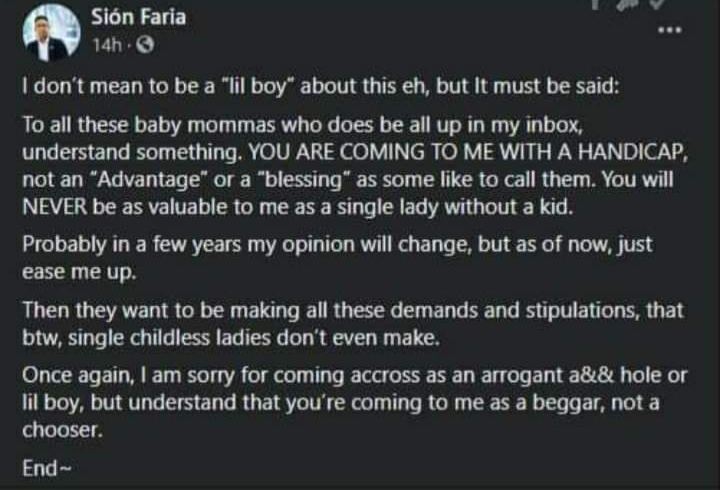
Well…it has been about one day since Trini Facebook was broken and now, it is nursing its wounds. In a viral post (screenshot below), one member of the red man association expressed frustration with the single mothers allegedly in his inbox. He had had enough and the day of reckoning was upon the beggars and their handicaps! Although I am of the view that too much has been said through comments and reposts, and although the original post has since been removed, I have a nagging desire to give my two cents on the matter. This is, after all, a blog about law, economics and Caribbean culture. And, this is culture! Besides, what else am I supposed to do in this lockdown?

To get it out of the way, it is objectively true that single mothers are at a disadvantage on the dating and marriage market. Men generally do not want to raise other men’s children. Hell, some men *cough black men cough* don’t even want to raise their own children. Don’t shoot the messenger because she’s having a bit of fun speaking the truth! That’s a discussion for another day and it is what it is. Bottom line is, the core idea of the post is true and Stevie Wonder could see that…

Nevertheless, I do take issue with the delivery. You see, there is a certain level of elegance that I expect of supposedly decent folk while they are in public, and this fell way below that standard. You can be right and be an a-hole (he accurately described himself as such), or you can be right while maintaining tact. As someone prone to bluntness who has had to rein it in to maintain healthier human interactions, I would know. Using the word handicap to describe a prospective mate’s children can be technically correct, but it is bound to leave a bad taste in people’s mouths. He was at liberty to make his statement, but I’m not at all surprised by people’s reactions. Some things are better if kept in one’s head instead of letting them roll off one’s tongue.

Nothing prevented the poster from exercising his agency in dating privately, but he made his PSA on Facebook…publicly…and THAT is where I think the juicy point can be made. Why did he do this? Was he really so frustrated that he had to? Were there so many unsavoury women in his inbox that making a public statement was rendered necessary? I think not and I must scrutinize the post!

The allegation was that there were “all these baby mommas” in his inbox. I find this improbable. On average, men do the asking and not women. Single mothers also tend to have a lot on their plates given that they have whole other humans for whom they are responsible. That many within this cohort had the time to be in his inbox seems highly unlikely to me. It may be true, but I find it difficult to believe.

The second allegation was that they were “demanding things which single, childless women do not demand”. I’m not sure whom he has been dealing with, but most women would not ask for things from men unless they have had some encouragement from those men. Perhaps I am mistaken, but I don’t know one woman who would do this without there first being some sort of rapport between herself and the man, and without gauging the probable outcome of making such a request and concluding that more likely than not, it would be positive.

Long story short, I think he made the post to get attention. He likely was trying to make it seem like he was in high demand so that some woman whom he was interested in would consider him a better prospect.

Well…attention he got! Single mothers (and some others) swarmed in to scold him! One does not just pelt a jep’s nest! Many, quite ironically, proved his point by not being aware that they were at a dating disadvantage… But, people were also noting his arrogance. I felt for him, but was VERY entertained, especially since the post had been shared early yesterday by a friend, and I paid it no mind. I took a nap and woke up to memes! Someone needs to apologise to Mouttxt on behalf of Trinbago!

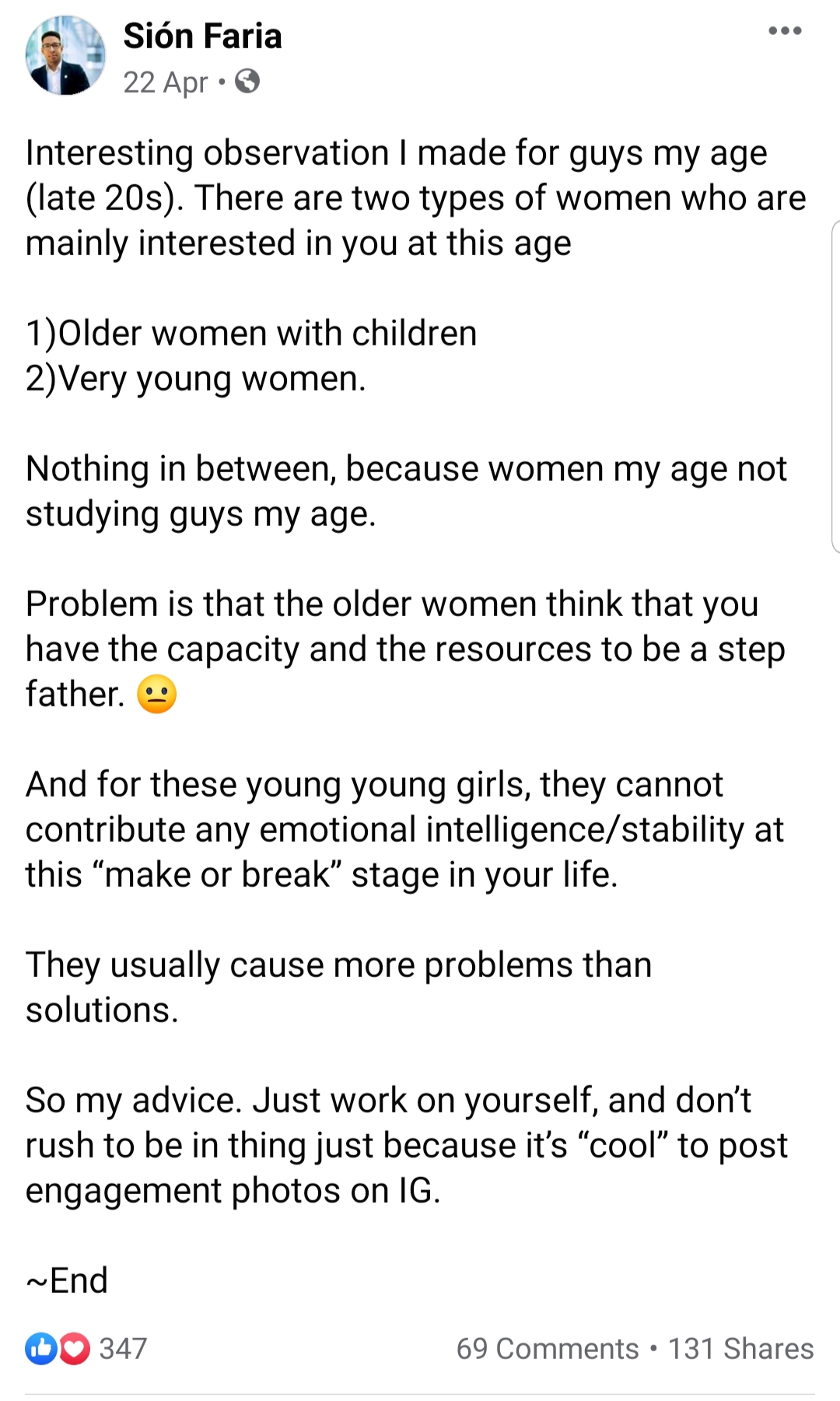
The part of the original post which I found most fascinating, however, was “you are coming to me as a beggar, not a chooser”. It reeked of so much condescension that it made me want to investigate further. Then, I found the gem below…

In his experience, women around his age (in their late 20s) are not interested in him. He also finds that older women with children, and younger women with no emotional intelligence are the ones available to him. The former expect him to be step-daddy from the jump. The latter cannot offer him the support he needs.

I was curious about whether this point on interest/availability was universally true since people tend to date, mate and marry within their age brackets, give or take four to five years in either direction. On average, women prefer men slightly older than them, who have some resources available, but not older by much. Naturally, I asked some (about 20) men, either in their late 20s or older now, but young enough to remember. It was comprised of mostly Trinis of various ethnicities and one white Brit. This was maccoing, not science, and I was that bored, so forgive me!

Only three of the men said that in their late twenties/early thirties, women their age weren’t interested in them. One admitted it was because he had no money. One said that the only woman around his age whom he had dated had a child, but that he mostly had younger women available. I know he also has no money (but he did not say that, so you didn’t hear it from me). The third said that he found that it was mostly slightly older Indian women whom were available, but he never took the bait. His now ex wife is a slightly younger Indian woman who was 28 when they married. He was 31 at that time.

The other Trinis said that younger women and women around their age were available and interested, and that none of the women were single mothers. The Brit said all ages were available and expressed interest, and none with children.

As is typical of women, I will jump to a conclusion. It’s more of a hypothesis than a conclusion, but after reading the posts I’ve shared together, and after browsing the poster’s public posts, I have a theory. Maybe it is not the children of single mothers that are the his primary handicap!

He seems to view himself as some sort of prize. To be fair, successful, childless black men are quite scarce, so that may be adding to his ego…but it takes some audacity to make a whole public facebook post expressing contempt for a cohort of women instead of simply exercising one’s agency and not dating them.

My hunch is that it is a combination of his arrogant personality, proclivity for emotional, attention-seeking, self-indulgent and self-aggrandizing facebook posts (which is feminine) and his overestimation of his own value that causes women within his age bracket to avoid him. I am childless and within his age bracket. I would avoid him like people avoid stopping on the Beetham stretch.

I think that any single mothers in his inbox requesting things are there on invitation, because it is not likely that women are chasing a man, and it is especially unlikely that they are requesting things from him unprovoked. I wait to be corrected.

I would like to thank the poster for bringing some much needed stimulation to an otherwise humdrum lockdown period. Yesterday would have been just another June Tuesday had he not offered himself as tribute. Instead, he gave me something to pretend to analyse. For that I am grateful. He’s at least good for one thing… Laughs! I laughed heartily.

Disloyalty is a VIRTUE: The Tribe of Principle.

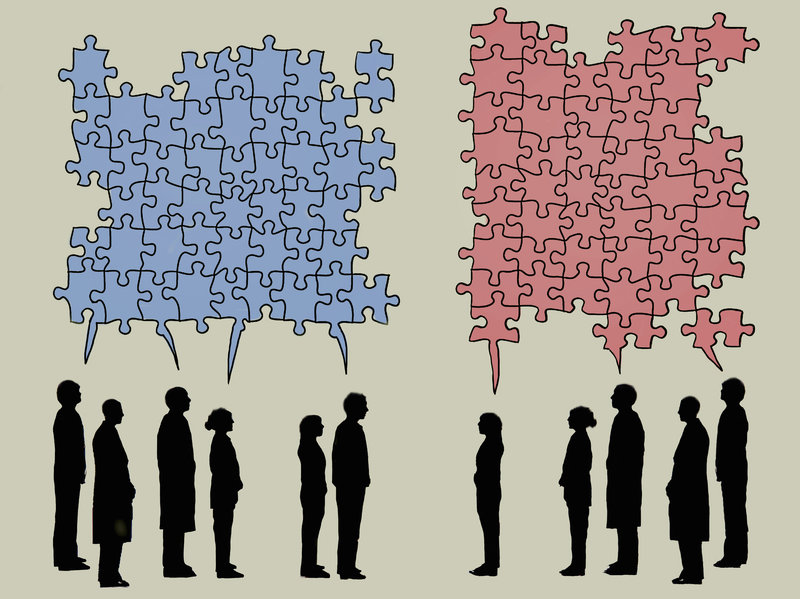
You have probably never wondered what African-American women have in common with Professor Richard Dawkins. I would not blame you. The comparison seems like one of chalk to cheese. Be that as it may, they have more in common with the brilliant professor than you could ever guess on any cursory observation. On the western side of the Atlantic, African-American women remain loyal to black men and to the black struggle. They continue to sacrifice themselves to maintain relationships which do not serve them, despite statistics which suggest that they should do the opposite. On the eastern side of the pond, the British DNA nerd has inadvertently made himself the sacrificial lamb at the progressive altar in an effort to maintain social and political capital. The cost to both African-American women and to Dawkins is their dignity, but it seems that this matters not. Humans are, of course, a tribal bunch. Tribalism is in our DNA as a social species and makes us love those similar to us more than others… as we should. Things go awry, however, when this innate tribalism affects our higher cognitive processes.

In Dawkins’ case, he asked a “dangerous” question on Twitter:

“In 2015, Rachel Dolezal, a white chapter president of NAACP, was vilified for identifying as Black. Some men choose to identify as women, and some women choose to identify as men. You will be vilified if you deny that they literally are what they identify as. Discuss.”

If both race and gender are social constructs as people in the postmodernist camp generally suggest, then any challenge to Dolezal’s assertion, like with transgender people, must stop at her subjective identification. It was a reasonable comparison of the two issues in my view, but reasonable comparisons seldom survive the onslaught of the Twitterati.

Tweet after tweet called for the prominent humanist’s head. Public atheists Matt Dillahunty and Hemant Mehta joined in the chant of “Transphobe! Transphobe! Transphobe!” eager to castigate the man for his alleged treachery. His transgression, they suggested, was to forsake science for bigotry. The flagellation continued for days and rumour has it Dawkins prayed.

Of course there were sensible voices in the crowd pleading for reason over the treason charge, but it was then that the kick from Dawkins came. He tweeted:

“I do not intend to disparage trans people. I see that my academic “Discuss” question has been misconstrued as such and I deplore this. It was also not my intent to ally in any way with Republican bigots in US now exploiting this issue.”

OUCH!

In The Square and the Tower: Networks, Hierarchies and the Struggle for Global Power, Hoover Institute Fellow and history Professor Niall Ferguson describes how communication technologies like the printing press, the internet and modern day social media are polarizing. According to Ferguson, they exacerbate our tribalism, whatever form that they take on in a given era, and are as effective (if not more effective) at spreading both harmful and helpful ideas. When they are utilized, people tend to divide themselves into echo chambers. Twitter is but one polarizing force, and anyone who has been on the platform long enough knows that you never, under any circumstance, EVER cave to the mob. It is social suicide. Nothing good comes of it, and it is pointless because apologies are worth nothing in the Twitterverse. To cave to the mob while simultaneously alienating the people who are defending your right to ask a question though? That is just pure gold!

In his book Against Empathy: A Case For Rational Compassion, Yale Professor of Psychology Paul Bloom proffers that empathy is sometimes useful, but not the ideal that we typically make it out to be. He argues that since our natural, knee-jerk empathy is more strongly felt for people we perceive as closer to ourselves, whether biologically or socially, it limits our capacity to give due attention to people and issues which are worthy of regard, but with which we cannot relate. Bloom highlights that empathy’s limitations can cloud our judgment and even cause us to do evil.

It is counterintuitive to think that it was empathy that made Dawkins do a Twitter kamikaze, but as complicated as it seems, it was exactly that dark, tribalistic side of empathy at play in this debacle. For decades, Dawkins has presented himself as the secular, liberal voice of reason, science and all things modern. His desire to maintain that reputation and his failure to keep his finger on the social pulse, however, caused him to err. Just as religion does not and cannot have a monopoly on morality, those who label themselves as progressive liberals do not and cannot monopolize reasonableness. Much of the censorship of valid, public discussion –the main thing Dawkins cherishes– has been championed by people whom he would not readily attach a label of “bigots” to, despite them being just that. Conversely, a lot of the time, it is those “Republican bigots” (and I hate the label just if that has not become obvious) who defend freedom of speech and of inquiry. This is not meant to absolve actual right-wing bigots from their bad behaviour. They can do deplorable things, much like other groups. When that happens, it is the responsibility of the reasonable masses to challenge them.

But it is not only “Republican bigots” who question the postmodernist construction ideology that transgenderism falls squarely within. It is not a tribal issue but a scientific one. What was required in the circumstance was loyalty, not to labels, but to ideas and principles. Had Dawkins remembered that, he would have been able to see the humanity in the “Republican bigots” he so quickly threw under the bus. A fruitful discussion could have been had as he originally intended, and this would have kept his reputation for non-partisan debate in tact as well.

Instead, he chose his desire to remain in the good books of progressive pundits by trying to straddle the fence. His intended clarification of his tweets did not sit well with many of the non-progressives who started off in his army, and that chink in his armor cost him his 1996 Humanist of the Year award from the American Humanist Association. It isn’t that the nonsensical revocation does much to his record, but that the idea that tribal labels and loyalty to them can be counterproductive still resonates. Sometimes, our ideas will have us associated with people whom we do not usually agree with, and that is okay.

For African-American women, the tale is much more grim.

In his book Is Marriage For White People?: How the African-American Marriage Decline Affects Everyone, Stanford Law Professor Ralph Richard Banks discusses the low marriage rates among African Americans and analyzes the reasons for them. Of note were African-American women’s loyalty to the “cultural swagger” of black men, and their hesitancy to interracially date and marry, which were described as inimical to their intimate relationship success. One has to look no further than this Brookings Institute paper to understand the problem and what has to be done, but at the risk of being pedantic, I will spell it out plainly below.

Heterosexual women are picky in mating because pregnancy is more of a biological risk and investment for women than it is for men. They marry men three to five years older than them on average, and also tend towards hypergamy, marrying across and up competence and dominance hierarchies. This is the typical human mating strategy, but there is nothing typical about the African-American community’s condition.

With high rates of incarceration, violent death and school dropout among young African-American men, their female counterparts outnumber and outperform them exponentially. If this was the case for men in general, it would cause a reversal in the human sexual dynamic. The paucity of high quality men would result in fiercer competition among women for the men at the top of the hierarchy. Is this the case among African-Americans? Absolutely!

The angry baby mama trope exists for a reason, and as Banks notes, the few black men who do succeed educationally and socioeconomically marry interracially at three times the rate as black women… if they even marry at all. Most do not marry because business is booming! They get sex, children, companionship and places to rest their heads, without having to invest anywhere near as much as African-American women do. It is the typical “Why by the cow when you can get the milk for free?” dynamic and it pays them in dividends.

Banks’ solution, of course, is that African-American women should publicly and seriously consider interracial relationships. Their choice to do this would reintroduce a more typical sexual dynamic, since there would be more men competing for their affections when word gets out about their openness. This would mean more opportunities for them to exercise their own sexual selectivity. It is common sense. It is math.

Like Dawkins did to the “Republicans” supporting him, however, swathes of African-American women choose to disparage people like Banks and like author Christelyn Karazin, who in her book Swirling: How to Date, Mate and Relate Mixing Race, Color and Creed, advocates for black women to entertain all their romantic options to maximize their relational happiness and success. Karazin has dedicated her professional life to the African-American woman’s plight, creating the No Wedding No Womb project to warn women about the negative consequences of out-of-wedlock maternity. She has even created a course, The Pink Pill, to help the lot strategize, through self-development, so that they could become more equipped to navigate newer, more affluent social circles.

What has she gotten in return? They take it as an affront to “blackness” and to the “honour” of the black man. She has been called a bed wench, a race traitor, and all manner of insulting things, while being told that she just wants to be white. The African-American women in whom she has invested all her sweat equity have teamed up with the black men who have them in their predicament and who, online and offline, demonstrate no apprehensions about expressing their obloquy for black women. The alliance is made along cultural and racial lines of course, and it only facilitates their own embarrassment. If these women were brave enough to disengage from their emotional reasoning and look at the statistics instead of shooting the messenger, I am certain that their romantic, social and economic outcomes would shift towards more favourable outcomes, but alas, tribalism!

I suppose I should get to the point of this post after all my chuntering. It is that tribal disloyalty is not an iniquity, but the truest virtue. The idea of rational compassion forwarded by Bloom addresses our altruistic choices, but I think it must be taken further. Generally speaking, it is tribalism which must be deliberately circumvented to maintain healthy social intercourse and secure better social, political and economic outcomes. I therefore propose that the antidote to our innate tribalism is an amalgamation of rational compassion with intentional disloyalty.

This proposal necessitates some clarification. I do not espouse the idea that objectivity is a social construct. In advocating for active disloyalty within the public square, I recognize that I run the risk of suggesting that we should approach problems as if nothing is true or real. That is the opposite of what I am suggesting, since certain ideas do underpin my proposal.

Firstly, I believe that through a process of rigorous inquiry, we can figure out the truth of most matters. That is the rational bit. Secondly, I believe that social engagement with ideas, even if they are bad, is more useful that censorship could ever be. That means that we must be willing to be disloyal to our biases and to those who agree with us, so that we can modify our points of view as necessary. Thirdly and finally, I believe that the human individual is valuable and should be treated with dignity. That is the compassion. Loyalty to these principles and active disloyalty to familiar people and institutions would help to solve the tribalism problem.

If we agree that there are objective truths and that we can decipher them through rigorous inquiry, then it puts us in the mind-frame of addressing the problem rather than the person. We would have a keen awareness that there is a destination which we can eventually reach it if we try hard enough. Depersonalizing the problem and stripping it down to its bare bones for the mutual benefit of edification is what science is all about. Fisher, Ury and Patton suggest that this is the principled approach to problem-solving and promote in their best-selling book on alternative dispute resolution, Getting To Yes.

To adopt a principled approach to problem solving is to be rational. We must be honest about our intentions in debate, must know what our desired outcomes are, must determine whether those outcomes are worth pursuing at any given moment, and must be open to the possibility of outcomes which we may not have originally expected. Importantly, we must divorce our sense of moral worth from the outcome of the inquiry process. If we accept that there are only facts, fictions, and opinions, then developing our skills of distinguishing these items can become our life’s work. This enables us to scrutinize ideas without diminishing people, and to get to the meat of our matters more efficiently.

If we agree that social engagement with ideas is more useful than censorship, then there are no dangerous questions. There are no shadows in which ideological monsters can hide. There are no book burnings and no fatwas and no mobs. There is no Twitterati. It seems idealistic because of our biology, but why would anybody not want to live in a world where his trivial transgressions (real or perceived) do not mean the end of his social life at any given moment? We can affirm not only our ability to pursue truth to its end, as above, but our duty to do so, and that duty becomes one owed not to ourselves or our kin, but to the process. This means that we are all responsible for ourselves, and for keeping each other in check, not through scarlet letters and the mental abuse of isolation, but through rational debate. There can be no loyalty in debate, because it requires us to shine a light on the weaknesses of our own positions.

Finally, if we agree that the individual is valuable and deserves dignity, then we cannot lazily ascribe group traits to him or presume that he embraces all the group’s ideas. We must humanize him and engage with him and him alone. This insures us against the presumption that a perceived opponent malicious, and simultaneously forbids us from assuming that certain people possess virtues and not others without evidence for this presumption. Perfectly reasonable people can disagree with us and unreasonable people can agree with us. Nobody is infallible…not even ourselves. Everybody is human and that sets the tone for our engagement.

It is only when our capabilities, duties and rules of engagement are clear that we can avoid excluding people who have our best interests at heart, but who appear to be from different tribes than ourselves. In one of my favourite plays, Fences by August Wilson, the protagonist Troy and his best friend Bono discuss the purpose of a fence. They conclude that fences are meant to keep people in as much as they are meant to keep people out. While our tribes and our differences define us in many ways, and the lines between us keep us both in and out of each others’ camps, there is no mandate that these are the only ways by which humans can be defined. We are more similar than we are different, and that is why we are all still here on this pale blue dot. In this information age where the tools of everyday life magnify the limitations of our empathy, and where the sociopolitical divisions in the west are pronounced because of the anonymity of screens, we must ensure that our fences do not become walls. Staying loyal to the basic principles outlined herein would mitigate against polarization, help to bridge gaps between people and yield the greatest good for the greatest number of people in the long term.