Skin.

By Shawnelle Martineaux

Your shipwreck got to shore without crashing.

Your cargo was splayed and frayed by its unbelonging.

They were marked black and glistened

In the heat.

They were not home.

They made do.

There was no home to go back to.

But there was history to make.

And lives. For you to take.

And time. For you to keep.

Just like their bodies kept score.

Sweet sugar and hot tea was had.

Every burden, they bore it.

For you.

One day, your mirror cursed at you.

You are not the fairest of them all!

So, you clenched your teeth.

You swiped your pen.

And of livestock, you made men.

They were free. For your taking.

Their identities, for your making.

No expectation of them waking.

Just go. Be.

But freedom brought the kiss of love.

And eyes opened wide and

touched the horizon, wanting…

more.

With your earworms whirling

in their minds

they got back on your ship that you built

with their blood, sweat, and tears.

Your shores beckoned them home.

And, when they answered,

you pretended they were not yours.

They were marked black and

It was harsh against the coldness of your

grey gloom.

Their skin is just a vessel

at your border.

Mother. Land.

It carries your stories.

It speaks your truth.

The gnarled thing inside it is all you.

Do you fear what you have become?

Is it true that the same sun

that never set on my back

never set on your empire?

Was it not you who made me

an English child

at bedtime, cradled at your breast?

Why can’t I come home?

Why don’t you claim me like you own me now?

You must be too good for your own devices.

But I’ll be sleeping

in the conservatory with the other delicate

things

you conveniently forget to tend to.

Maybe one day in the spring sun,

I’ll grow into your prized courgette.

And you can peel me and see that I

am good inside.

Then, you can have me for lunch.

Populists, Anchor Babies, Diplomats, and Vivek Ramaswamy.

When Vivek Ramaswamy withdrew from the US presidential race, I was overjoyed. He has since endorsed ex-president and fellow businessman Donald Trump… It’s not ideal… but he’s no longer running, which is great. My issues with Vivek can be summed up in two main points: 1. I think that he is an opportunistic and unprincipled populist, and 2. I think that he is a hypocrite. These points overlap in many ways, but I’ll discuss them seriatim below.

Opportunistic Vivek

It is, of course, at the forefront of my mind that Vivek was a politician marketing himself as a businessman first. He is a brand, first and foremost. It is the fact that he is a successful businessman who chose to enter the political ring that makes him a politician. All politiciams should be scrutinised because they are inherently opportunistic until they prove otherwise. Substantively, I think that much of the guy’s campaign focussed on undocumented immigrants and “securing the border,” not because he was particularly passionate about the subject matter, but because he knew that it worked for Trump in 2016.

He chose to adopt the populism that Trump exploited because he knew that it was a formula for incensing the working class masses of Middle America. I am not a fan of populists or anti-immigrant sentiments, but the borderline fascistic ideology is only a small part of what grinds my gears. It is the insult that upsets me more.

The intentional exploitation of xenophobic tendencies for political gain gave me pause, especially because I knew that it was intentional. Everything he did was intentional. It may be the libertarianism values I espouse, or the bored theatre kid in me, but when I close my eyes and think of Vivek, the image that energes is a seething Patrick Bateman mid-bludgeon, enjoying his orgasmic, psychopathic thrills. Only, instead of bludgeoning someone to death, he is insulting people’s intelligence.

Deep down, I genuinely believe that Vivek thinks that “those people” are too silly to be reasoned with, and as a result, he has to emotionally manipulate them into supporting him by fuelling their sense of lack. It is run-of-the-mill marketing, but it is still insulting. I would more quickly trust a shark that told me it just wanted to speak about its lord and saviour Jesus Christ while I had an open wound and was bleeding out on the Pacific Ocean floor than trust a word that comes out of opportunistic Vivek’s mouth!

To facilitate his condescending opportunism, he opined that the children of undocumented immigrants should be denied birthright citizenship in the same way that the children of diplomats are denied the same. The argument was dumb. Vivek proffered that it was because diplomats were not subject to the law that they could not receive that citizenship benefit. His dubious analogy was that undocumented immigrants were criminals and, therefore, were not subject to US law. As such, their children born on US soil should not receive the Constitutional birthright citizenship.

To the drunk or the illiterate, the comparison was sensible. To the sensible, it was drunk and illiterate. The pesky little fact that being a criminal requires a person to be subject to the criminal jurisdiction (which diplomats are not) and be convicted as such (which diplomats cannot be), gets in the way of that tirade. A smart, Harvard-trained lawyer would know that this was foolish circular reasoning…but convenience trumped reasoning because those people are too stupid to know that. I rest my case on this point.

Hypocritical Vivek

A perfect example of that unfortunate man’s opportunism was his hypocrisy when it came to market principles. Our dearest Vivek took to Twitter to praise Javier Milei’s deregulation of the Argentine housing market and the consequent doubling of supply with 20% down and decreasing rents. Vote for him, he said, and it would be a vote for deregulated markets! He conveniently knew of the benefits of deregulated markets but refused (or failed—which is worse) to acknowledge that those same principles applied to labour… and therefore immigration by extension!

This was a most disturbing foursome among himself, Hayek, Friedman, and Keynes, and was very disappointing. Protectionism has never known a prettier, more deceitful face!

To add insult to injury, all this lamenting and fomenting about anchor babies while using market economics like a Miss America world peace campaign came from the chief anchor baby!

Vivek, a first-generation American immigrant, was, through his magical birthright citizenship, the means by which his own mother could become an American. His father, who was on a non-immigrant visa, and who is still not a US citizen, was his family’s route to the US and the only reason dearest Vivek was able to have the opportunities that he could in Ohio. He chose to become the chief campaigner against himself, making a narrow distinction based on the fact of his father’s visa, knowing fully well that his intelligent Indian compatriots whom US citizens want to hire are unable to get work visas because of systemic failures brought about by the kinds of policies he was endorsing. Much less for the remainder of non-Indians whom US citizens also want to hire, who cannot legally enter the US workforce because of counterproductive, bureaucratic nonsense.

I don’t know about you, but a person who not only warns but tries to prevent me from doing the very thing he did, which worked for him, is not trustworthy. That is the epitome of hypocrisy. With that thought, I leave you to think, knowing that in about four years, this man will show up again to try and charm the boxers off many a Midwestern, beer-drinking uncle.

Newspapers are Unserious.

I’m a libertarian, and as a libertarian, very few things provoke an emotional response in me. My sacred cow is that I do not believe in the veneration of sacred cows, and generally speaking, I prefer pragmatism and efficiency over much else. Be that as it may, encroachments on freedom of thought and expression cause me a particular kind of gripe which I must address. I am at least somewhat moralistic about these topics, but there are practical reasons, such as the need for efficient social intercourse, and the value of having the most information available to the public, which I use to justify my moral fervour in this regard. It disappoints me that the journalistic standards applied in Trinidad and Tobago, much like the politics, are from and for the gutter. Everyone seems to be in a race towards the bottom of a very deep, very murky drain.

In 2016, a gang of blood-thirsty dogs, armed with social clout, credentials and, frothing at the mouth, successfully conspired to expel my friend, satirist Kevin Baldeosingh, from the Trinidad and Tobago Guardian. The stab to the back came mere days after the paper’s management had confirmed the renewal of his contract as a columnist. The excuse given was finances, but it was obvious that the contents of his weekly column making the case that a Muslim woman was making a rational choice by choosing to wear her hijab at the expense of a job, was twisted to make him seem discriminatory and used to justify the sudden 180. The newspaper even apologised, and only one other columnist said anything to defend Kevin’s right to think and say what he wanted…he eventually was convicted of attempted murder and conspiring to execute his ex-girlfriend in Florida, but that’s a story for another day. Kevin was and still is a devoted family man. He had two toddlers and a young wife who was studying at the time. He had bills. It must have been a shock. I can only imagine how disorienting that experience would have been.

Now, I must clarify that the newspapers also have a right of freedom to associate. By no means are they obligated to hire someone unless they want to do so. If it was a matter of merely ending a contract, I would have very little to say. The media massacre that ensued, followed by the obvious blacklisting and silencing of a writer who had the longest-running and one of the highest-grossing columns in Trinidad and Tobago history distinguishes this situation and makes it more than an expression of the newspapers’ freedom to associate. This is especially so, because some months later, a columnist and gender feminist, Dr. Gabrielle J. Hosein, would casually thank her co-conspirators for assisting her with Kevin’s ousting using her column. The crime was, in reality, him daring to disagree with her ideas over the years, but she framed it as him targeting and bullying her. All he did was provide evidence which was contrary to her narrative and obvious agenda in a satirical way? Hosein’s lack of compunction and her clear use of her victim card to gather her troops—typical of female bullies—no doubt disturbed me. But it was the fact that she used the media to champion her anti-free speech, tribalistic position which made me want to vomit. That felt like mockery of liberal democracy itself!

Perhaps the problem lies there? Maybe the expectation that the Trinidad and Tobago media would seek to preserve its own reliability and integrity was too high. Maybe it is filled with members who are morally bereft. I know that what disgusts me clearly does not disgust others and I suppose that that sufficiently explains what transpired. This would also explain the complete failure of the journalistic institutions during the Covid-19 Pandemic of the last three years. I do not think that freedom of thought and expression should be partisan issues. These encroachments should disgust anyone remotely interested in living in a free, prosperous and healthy society. I am not sure how to make that ideological front the true and only tribal war.

That being said. imagine my complete surprise, though, when I read the March 1, 2023, Editorial by Mr. Curtis Williams, Trinidad and Tobago Express’ new Managing Editor, and learnt that contrary to my understanding, the media powers that be in Trinidad and Tobago care about protecting freedom of thought and expression. Utter shock! Understand that I try my best not to be a hypocrite. That others can freely engage in grand acts of hypocrisy such as this without feeling anything is the eighth wonder of the world to me. Mr. Williams and his editorial team are worthy of a place in The Guinness Book of World Records for this feat. I know that Kevin has been trying to write locally again. I know that I (and others) have been petitioning to have him write locally again since 2016. And, although Mr. Williams is fairly new to his role as managing editor, I know that he knows of this miscarriage of justice, because I wrote a letter to the editor in response to his flowery editorial some time ago. Has he actually attempted to adhere to his alleged principles? Nope! Will I let it rest? On principle, absolutely not! I refuse to allow media institutions to rot without talking about the smell. I am not ethically impotent.

Principles aside, as a fellow human, I know what it feels like to be targeted by a mob in my professional and academic life. I know what it is like for people to intentionally misinterpret and then misrepresent what I say, then use that misrepresentation and their social ties to exclude me from opportunities and groups. I went to girls’ schools all my life up until university. It did not get better at university or law school, mostly because I am not the kind of person who can see wrong things happening and just leave it be. These are not experiences I would wish upon my worst enemy, not because it is insurmountable, but because it is an immense waste of time and resources. I feel driven to say or do something when I notice wrong, and my big mouth gets me into trouble with bureaucrats in love with corruption and the status quo. I could live with that.

The kind of professional thuggery that is overtaking our institutions is unseemly and counterproductive. This misuse of the media and the infusion of female-typical aggression into the professional sphere where merit ought to be supreme is unbecoming. The media is an institution which ought to be preserved for the benefit of all, and its undoing in a manner this juvenile, anti-intellectual and anti-human is disgraceful. This is why no good writers remain on staff locally, why the editing skills are atrocious, and why our local intellectual life will continue to be sub-par. The same anti-intellectual forces that have tried to silence Salman Rushdie, that have killed Theo Van Gogh, that have made Ayaan Hirsi Ali’s security detail necessary, that have tried to get Bruce Gilley to stop asking questions and sharing heterodox ideas, and that have made V.S. Naipaul a local pariah are the ones which are conspiring to undo Kevin. This needs to stop before it is too late.

You may support Kevin by clicking this link and purchasing his books on Amazon. He writes really well, and he thinks!

The Death of Civilisation?

Two ideas popped into my head at about 2 a.m. today and I thought that it would be best to write them down. They are somewhat connected, albeit loosely. I am still processing them, so they are more postulations than conclusions, but in the words of JBP, you write to find out what you think!

The first idea is that as a civilisation moves beyond its physicality, it begins losing its identity and the people within it also become more prone to losing their identities.

Western civilisation has moved more and more away from the physicality of industry and more and more towards a digital age of ideas. Things which have been traditionally physical, such as newspapers, money etc. have gone digital for the most part and have gone through process of stripping them down to their bare bones. The idea of a newspaper or of money is what remains.

Similarly, the idea of identity seems to be less tethered to the body and what it does. There is a popular description of things as social constructs and seemingly constant experimentation in that regard on the one hand, yet people seem to be in more identity crises than previously.

My suspicion is that this social trend towards disembodied identity is a response to the world itself becoming less embodied. Humans are, after all, a part of their world. It would explain why these ideas take root much easier among intellectuals than working class people.

The second idea is much easier to conceptualize, though I am not entirely sure if it is original. I think that western civilisation has an autoimmune disorder.

As information becomes more available, it seems that autoimmune disorders are linked to leaky gut. The tight junctions between intestinal cells are weaker because of some chemical process and so things which typically would have remained on the outside of the body (the digestive tract is actually a long tube through rather than inside of the body) are leeching into it. This seems to be tied, at least in part, to ingesting certain proteins like gluten in quantities which are too large and for periods which are too long. The weakening of these tight junctions and the leeching in of these toxins cause the body to malfunction and mount an immune response against itself.

Similarly, western civilisation seems to have ingested the ideas of postmodernism that there is no inherent value in its precepts and that everything is relative. These ideas are leeching into its institutions and these very institutions are malfunctioning and self-destructing by adhering to select values. e.g. openmindedness, intellectualism, markets.

Anyway, those are some crude explanations which are far from thorough I’m going back to bed.

Disloyalty is a VIRTUE: The Tribe of Principle.

You have probably never wondered what African-American women have in common with Professor Richard Dawkins. I would not blame you. The comparison seems like one of chalk to cheese. Be that as it may, they have more in common with the brilliant professor than you could ever guess on any cursory observation. On the western side of the Atlantic, African-American women remain loyal to black men and to the black struggle. They continue to sacrifice themselves to maintain relationships which do not serve them, despite statistics which suggest that they should do the opposite. On the eastern side of the pond, the British DNA nerd has inadvertently made himself the sacrificial lamb at the progressive altar in an effort to maintain social and political capital. The cost to both African-American women and to Dawkins is their dignity, but it seems that this matters not. Humans are, of course, a tribal bunch. Tribalism is in our DNA as a social species and makes us love those similar to us more than others… as we should. Things go awry, however, when this innate tribalism affects our higher cognitive processes.

In Dawkins’ case, he asked a “dangerous” question on Twitter:

“In 2015, Rachel Dolezal, a white chapter president of NAACP, was vilified for identifying as Black. Some men choose to identify as women, and some women choose to identify as men. You will be vilified if you deny that they literally are what they identify as. Discuss.”

If both race and gender are social constructs as people in the postmodernist camp generally suggest, then any challenge to Dolezal’s assertion, like with transgender people, must stop at her subjective identification. It was a reasonable comparison of the two issues in my view, but reasonable comparisons seldom survive the onslaught of the Twitterati.

Tweet after tweet called for the prominent humanist’s head. Public atheists Matt Dillahunty and Hemant Mehta joined in the chant of “Transphobe! Transphobe! Transphobe!” eager to castigate the man for his alleged treachery. His transgression, they suggested, was to forsake science for bigotry. The flagellation continued for days and rumour has it Dawkins prayed.

Of course there were sensible voices in the crowd pleading for reason over the treason charge, but it was then that the kick from Dawkins came. He tweeted:

“I do not intend to disparage trans people. I see that my academic “Discuss” question has been misconstrued as such and I deplore this. It was also not my intent to ally in any way with Republican bigots in US now exploiting this issue.”

OUCH!

In The Square and the Tower: Networks, Hierarchies and the Struggle for Global Power, Hoover Institute Fellow and history Professor Niall Ferguson describes how communication technologies like the printing press, the internet and modern day social media are polarizing. According to Ferguson, they exacerbate our tribalism, whatever form that they take on in a given era, and are as effective (if not more effective) at spreading both harmful and helpful ideas. When they are utilized, people tend to divide themselves into echo chambers. Twitter is but one polarizing force, and anyone who has been on the platform long enough knows that you never, under any circumstance, EVER cave to the mob. It is social suicide. Nothing good comes of it, and it is pointless because apologies are worth nothing in the Twitterverse. To cave to the mob while simultaneously alienating the people who are defending your right to ask a question though? That is just pure gold!

In his book Against Empathy: A Case For Rational Compassion, Yale Professor of Psychology Paul Bloom proffers that empathy is sometimes useful, but not the ideal that we typically make it out to be. He argues that since our natural, knee-jerk empathy is more strongly felt for people we perceive as closer to ourselves, whether biologically or socially, it limits our capacity to give due attention to people and issues which are worthy of regard, but with which we cannot relate. Bloom highlights that empathy’s limitations can cloud our judgment and even cause us to do evil.

It is counterintuitive to think that it was empathy that made Dawkins do a Twitter kamikaze, but as complicated as it seems, it was exactly that dark, tribalistic side of empathy at play in this debacle. For decades, Dawkins has presented himself as the secular, liberal voice of reason, science and all things modern. His desire to maintain that reputation and his failure to keep his finger on the social pulse, however, caused him to err. Just as religion does not and cannot have a monopoly on morality, those who label themselves as progressive liberals do not and cannot monopolize reasonableness. Much of the censorship of valid, public discussion –the main thing Dawkins cherishes– has been championed by people whom he would not readily attach a label of “bigots” to, despite them being just that. Conversely, a lot of the time, it is those “Republican bigots” (and I hate the label just if that has not become obvious) who defend freedom of speech and of inquiry. This is not meant to absolve actual right-wing bigots from their bad behaviour. They can do deplorable things, much like other groups. When that happens, it is the responsibility of the reasonable masses to challenge them.

But it is not only “Republican bigots” who question the postmodernist construction ideology that transgenderism falls squarely within. It is not a tribal issue but a scientific one. What was required in the circumstance was loyalty, not to labels, but to ideas and principles. Had Dawkins remembered that, he would have been able to see the humanity in the “Republican bigots” he so quickly threw under the bus. A fruitful discussion could have been had as he originally intended, and this would have kept his reputation for non-partisan debate in tact as well.

Instead, he chose his desire to remain in the good books of progressive pundits by trying to straddle the fence. His intended clarification of his tweets did not sit well with many of the non-progressives who started off in his army, and that chink in his armor cost him his 1996 Humanist of the Year award from the American Humanist Association. It isn’t that the nonsensical revocation does much to his record, but that the idea that tribal labels and loyalty to them can be counterproductive still resonates. Sometimes, our ideas will have us associated with people whom we do not usually agree with, and that is okay.

For African-American women, the tale is much more grim.

In his book Is Marriage For White People?: How the African-American Marriage Decline Affects Everyone, Stanford Law Professor Ralph Richard Banks discusses the low marriage rates among African Americans and analyzes the reasons for them. Of note were African-American women’s loyalty to the “cultural swagger” of black men, and their hesitancy to interracially date and marry, which were described as inimical to their intimate relationship success. One has to look no further than this Brookings Institute paper to understand the problem and what has to be done, but at the risk of being pedantic, I will spell it out plainly below.

Heterosexual women are picky in mating because pregnancy is more of a biological risk and investment for women than it is for men. They marry men three to five years older than them on average, and also tend towards hypergamy, marrying across and up competence and dominance hierarchies. This is the typical human mating strategy, but there is nothing typical about the African-American community’s condition.

With high rates of incarceration, violent death and school dropout among young African-American men, their female counterparts outnumber and outperform them exponentially. If this was the case for men in general, it would cause a reversal in the human sexual dynamic. The paucity of high quality men would result in fiercer competition among women for the men at the top of the hierarchy. Is this the case among African-Americans? Absolutely!

The angry baby mama trope exists for a reason, and as Banks notes, the few black men who do succeed educationally and socioeconomically marry interracially at three times the rate as black women… if they even marry at all. Most do not marry because business is booming! They get sex, children, companionship and places to rest their heads, without having to invest anywhere near as much as African-American women do. It is the typical “Why by the cow when you can get the milk for free?” dynamic and it pays them in dividends.

Banks’ solution, of course, is that African-American women should publicly and seriously consider interracial relationships. Their choice to do this would reintroduce a more typical sexual dynamic, since there would be more men competing for their affections when word gets out about their openness. This would mean more opportunities for them to exercise their own sexual selectivity. It is common sense. It is math.

Like Dawkins did to the “Republicans” supporting him, however, swathes of African-American women choose to disparage people like Banks and like author Christelyn Karazin, who in her book Swirling: How to Date, Mate and Relate Mixing Race, Color and Creed, advocates for black women to entertain all their romantic options to maximize their relational happiness and success. Karazin has dedicated her professional life to the African-American woman’s plight, creating the No Wedding No Womb project to warn women about the negative consequences of out-of-wedlock maternity. She has even created a course, The Pink Pill, to help the lot strategize, through self-development, so that they could become more equipped to navigate newer, more affluent social circles.

What has she gotten in return? They take it as an affront to “blackness” and to the “honour” of the black man. She has been called a bed wench, a race traitor, and all manner of insulting things, while being told that she just wants to be white. The African-American women in whom she has invested all her sweat equity have teamed up with the black men who have them in their predicament and who, online and offline, demonstrate no apprehensions about expressing their obloquy for black women. The alliance is made along cultural and racial lines of course, and it only facilitates their own embarrassment. If these women were brave enough to disengage from their emotional reasoning and look at the statistics instead of shooting the messenger, I am certain that their romantic, social and economic outcomes would shift towards more favourable outcomes, but alas, tribalism!

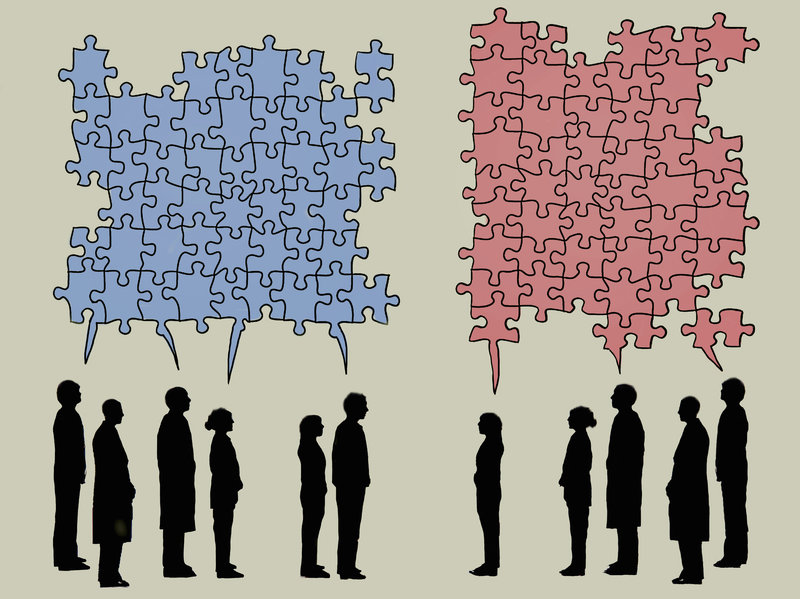
I suppose I should get to the point of this post after all my chuntering. It is that tribal disloyalty is not an iniquity, but the truest virtue. The idea of rational compassion forwarded by Bloom addresses our altruistic choices, but I think it must be taken further. Generally speaking, it is tribalism which must be deliberately circumvented to maintain healthy social intercourse and secure better social, political and economic outcomes. I therefore propose that the antidote to our innate tribalism is an amalgamation of rational compassion with intentional disloyalty.

This proposal necessitates some clarification. I do not espouse the idea that objectivity is a social construct. In advocating for active disloyalty within the public square, I recognize that I run the risk of suggesting that we should approach problems as if nothing is true or real. That is the opposite of what I am suggesting, since certain ideas do underpin my proposal.

Firstly, I believe that through a process of rigorous inquiry, we can figure out the truth of most matters. That is the rational bit. Secondly, I believe that social engagement with ideas, even if they are bad, is more useful that censorship could ever be. That means that we must be willing to be disloyal to our biases and to those who agree with us, so that we can modify our points of view as necessary. Thirdly and finally, I believe that the human individual is valuable and should be treated with dignity. That is the compassion. Loyalty to these principles and active disloyalty to familiar people and institutions would help to solve the tribalism problem.

If we agree that there are objective truths and that we can decipher them through rigorous inquiry, then it puts us in the mind-frame of addressing the problem rather than the person. We would have a keen awareness that there is a destination which we can eventually reach it if we try hard enough. Depersonalizing the problem and stripping it down to its bare bones for the mutual benefit of edification is what science is all about. Fisher, Ury and Patton suggest that this is the principled approach to problem-solving and promote in their best-selling book on alternative dispute resolution, Getting To Yes.

To adopt a principled approach to problem solving is to be rational. We must be honest about our intentions in debate, must know what our desired outcomes are, must determine whether those outcomes are worth pursuing at any given moment, and must be open to the possibility of outcomes which we may not have originally expected. Importantly, we must divorce our sense of moral worth from the outcome of the inquiry process. If we accept that there are only facts, fictions, and opinions, then developing our skills of distinguishing these items can become our life’s work. This enables us to scrutinize ideas without diminishing people, and to get to the meat of our matters more efficiently.

If we agree that social engagement with ideas is more useful than censorship, then there are no dangerous questions. There are no shadows in which ideological monsters can hide. There are no book burnings and no fatwas and no mobs. There is no Twitterati. It seems idealistic because of our biology, but why would anybody not want to live in a world where his trivial transgressions (real or perceived) do not mean the end of his social life at any given moment? We can affirm not only our ability to pursue truth to its end, as above, but our duty to do so, and that duty becomes one owed not to ourselves or our kin, but to the process. This means that we are all responsible for ourselves, and for keeping each other in check, not through scarlet letters and the mental abuse of isolation, but through rational debate. There can be no loyalty in debate, because it requires us to shine a light on the weaknesses of our own positions.

Finally, if we agree that the individual is valuable and deserves dignity, then we cannot lazily ascribe group traits to him or presume that he embraces all the group’s ideas. We must humanize him and engage with him and him alone. This insures us against the presumption that a perceived opponent malicious, and simultaneously forbids us from assuming that certain people possess virtues and not others without evidence for this presumption. Perfectly reasonable people can disagree with us and unreasonable people can agree with us. Nobody is infallible…not even ourselves. Everybody is human and that sets the tone for our engagement.

It is only when our capabilities, duties and rules of engagement are clear that we can avoid excluding people who have our best interests at heart, but who appear to be from different tribes than ourselves. In one of my favourite plays, Fences by August Wilson, the protagonist Troy and his best friend Bono discuss the purpose of a fence. They conclude that fences are meant to keep people in as much as they are meant to keep people out. While our tribes and our differences define us in many ways, and the lines between us keep us both in and out of each others’ camps, there is no mandate that these are the only ways by which humans can be defined. We are more similar than we are different, and that is why we are all still here on this pale blue dot. In this information age where the tools of everyday life magnify the limitations of our empathy, and where the sociopolitical divisions in the west are pronounced because of the anonymity of screens, we must ensure that our fences do not become walls. Staying loyal to the basic principles outlined herein would mitigate against polarization, help to bridge gaps between people and yield the greatest good for the greatest number of people in the long term.

Nuance, not race.

It has been an interesting few days. Over the weekend, I watched the story of a hit piece on Yale Law Professor, Amy Chua unfold. On April 8, 2021, she shared a letter alleging that she was being victimized by Yale administrators based on false allegations that she hosted dinner parties in breach of COVID-19 Guidelines. Then, news of Caron Nazario, a US Army Lieutenant who was pepper sprayed at gunpoint during a traffic stop for not having a licence plate spread like wildfire. The story of Daunte Wright being shot after he resisted arrest and attempted to escape police custody completed the unholy trinity of occurrences that have bewildered me. On their faces, all three of these stories seem unrelated, but a common thread connects them. That is, identity politics. I find it all intellectually lazy.

In Chua’s case, she took to Twitter on Saturday to say that the Yale administration did not expect her to fight back as an Asian-American woman. She provided no evidence of racially motivated hate, and stated her unsubstantiated sentiments boldly, as if any questioning of her narrative would be proof of the thing alleged. In the Nazario and Wright cases, Black Lives Matter activists predictably took the opportunity to “peacefully protest” (the well-known euphemism for “riot”), all based on the unsubstantiated presumption that the men were treated the way they were because of skin colour. What’s more, looting is being described as “material liberation” and as usual, the bad behaviour of hooligans is being justified by those plagued by the bigotry of low expectations.

Whenever baseless assertions about racism are thrown about, they rob the persons alleging mistreatment of credibility. In my view, Chua’s situation raises a major issue of a breach of confidentiality perpetrated by the Yale administration, which ought to be independently investigated. Yale has a lot to answer for in their treatment of her. Her eagerness to weaponize her race, however, made me wonder whether there was merit to the allegations raised against her. If there are no skeletons in one’s closet, then sticking to the pertinent issues should be the best move. Imputing racial malice to persons without providing evidence of it would be a lazy jab and a grab, not even at low-hanging fruit, but at fruit already on the ground. That kind of personal debasement is telling of how entrenched identity politics has become in the US.

As regards Lieutenant Nazario, an opportunity to address the very real issue of the US Police’s use of force presented itself. This useful discussion is being drowned out by the race-baiters who thought it necessary to mention that Nazario was an Afro-Latino, despite no evidence of racial motivation in the body cam footage. I am of the opinion that the officer who pepper-sprayed Nazario and his dog was belligerent. I am of the opinion that he was a textbook a-hole. I am of the opinion that he was power-hungry. I have no evidence that he was racist. Further, he has since been fired. The other officer, who seemed reasonable in the circumstances, seemed to be of lower rank than his loud counterpart and he complied with orders while still attempting to assist Nazario with his compliance. Hitting Nazario, pepper-spraying him for no obvious reason, and making him lay on the ground when he was pulled over for a missing licence plate? UTTERLY UNCALLED FOR! Nazario is suing and justice will be served, based on the evidence presented to the judge. The chips will fall where they may.

I think that Wright’s case is different. In the body cam footage, he very clearly resisted arrest. He also clearly attempted to escape. They were aware of a warrant for his arrest for possession of an illegal firearm, and so his detention was lawful. The officer who shot him shouted “Taser! Taser! Taser!” before firing her weapon. She expressed complete shock and regret immediately after she realized what she had done. I think it was an honest mistake, but honest mistakes can also be reckless. Reckless, fatal mistakes are called manslaughter. Manslaughter is a crime, which, if proved by evidence, can result in jail time.

I do not think that someone who could so easily mistake a gun for a taser should be carrying either of those weapons, as her fitness for office would be very clearly compromised. I also do not think that the officer did what she did because she hated black people, as is the narrative that is being pushed. Had it been her black partner— the person initially arresting Wright— what would have been the narrative?

All in all, I think that neither race-baiting moaners nor trigger-happy cops should be held up as beacons of society. More so, at least in the case of the latter cohort, they are not representative of their groups. Failing to acknowledge that causes unnecessary strife and social degradation. We must approach everything with sobriety of mind, fairness, and basic sense. We have all spent too long thinking tribally, and cities are burning because of it. I think conversations between reasonable people are long overdue.

Long live reason!

Aďdendum: After watching this video of the Nazario detention, I can understand the officers’ perspective a bit better. The belligerent officer seems more reasonable.